
More Information
Submitted: June 15, 2026 | Accepted: August 10, 2026 | Published: August 11, 2026
Citation: Bhosale SS. Development and Evaluation of Metal Salt-Based Invisible Inks for Forensic Document Examination on Different Paper Substrates. J Forensic Sci Res. 2026; 10(2): 88-98. Available from:
https://dx.doi.org/10.29328/journal.jfsr.1001120
DOI: 10.29328/journal.jfsr.1001120
Copyright license: © 2026 Bhosale SS. This is an open access article distributed under the Creative Commons Attribution License, which permits unrestricted use, distribution, and reproduction in any medium, provided the original work is properly cited.
Keywords: Invisible ink; Forensic document examination; Metal salt inks; Copper sulphate; Ferrous sulphate; Zinc sulphate; Potassium ferrocyanide; UV fluorescence; Anticounterfeiting; Latent writing detection

Development and Evaluation of Metal Salt-Based Invisible Inks for Forensic Document Examination on Different Paper Substrates
Shraddha Shahaji Bhosale**
Department of School of Behavioural and Forensic Sciences, JSPM University, Pune, Maharashtra, India
*Corresponding author: Shraddha Shahaji Bhosale, Department of School of Behavioural and Forensic Sciences, JSPM University, Pune, Maharashtra, India, E-mail: [email protected]
There are many applications for invisible inks including security communications, verifying documents, and forensic evidence to name a few. The goal of this project was to determine how effective 3 different metal salt-based invisible inks (copper sulphate, ferrous sulphate, and zinc sulphate) on various types of paper. To develop the hidden writings 6 different chemical agents were used (sodium hydroxide, potassium ferrocyanide, sodium carbonate, ethanol, hydrogen peroxide, and ammonia). The invisible inks that were created were applied to white, coloured, and glossy papers, and after applying the reagents to the treated papers, the corresponding writings were evaluated under normal and ultraviolet (UV) light using the criteria of colour development, visibility, and fluorescence. The research found that copper sulphate was the best performing type of the three inks that were tested in terms of colour development and visibility on most paper types, and that all 6 reagents provided satisfactory results for successfully revealing the hidden writings. Ferrous sulphate was found to be moderately effective providing that most of the latent writings were not visible under normal light conditions, however, they were revealed when the papers were exposed to long wave UV light. At the same time, ultraviolet (UV) examination of latent writings on white and brown substrates had revealed materials which are otherwise undetectable through visible examination. This study illustrated the importance of the relationship between the metal salt, the detection reagent, and the paper substrate as factors in the efficacy of an invisible ink system. The results of this study showed that copper sulphate, then ferrous sulphate, were the most effective, with zinc sulphate demonstrating relatively low levels of efficiency when used as a metal salt with the corresponding detection reagent on paper substrates. The results of this study demonstrate the value of chemical visualization methods and ultraviolet (UV) examination as forensic document analysis and anti-counterfeiting techniques and how they can be applied in demonstrating the detection of invisible inks based upon metal salt.
Today's Document World the Role of Documents: Today's information-rich society has developed documents into major devices for creating recording communicating and protecting important information.Documents are used extensively for personal, commercial government and legal purposes and may include various types of records like birth certificates diplomas contracts wills bank statements auto insurance policies deeds and personal letters.The credibility of the document will be important as many of the documents provide evidence of an individual's identity ownership of an item the existence of a right or obligation and the fulfilment of a law.New technology and the methods used to produce documents have resulted in the occurrence of much more document fraud and manipulation compared to past years.Crimes involving forged signatures altered documents counterfeit documents and false evidence create a serious threat to the integrity of the legal and administrative systems.As a result the need for dependable methods to verify the authenticity of such documents is increasing.The forensic science specialty field of forensic document examination provides a systematic way to address the above issues using the scientific analysis of questioned documents. Forensic document examiners use scientific and investigative methods to determine if a document is genuine if document changes or alterations have occurred and to provide expert testimony regarding documents related to civil and criminal investigations [1,2] In the examination of a document there are several characteristics that are examined however the examination of handwriting and written entries are of particular importance as both contain many distinguishing characteristics that can assist in determining the authorship and authenticity of such writings.
Materials required
Copper Sulfate, Ferrous Sulfate, Zinc Sulfate, Sodium Hydroxide, Potassium Ferrocyanide, Sodium Carbonate, Ethanol, Hydrogen Peroxide, Ammonia Solution, Different coloured papers, Glossy paper, Earbuds (cotton swabs), Spray bottles, Distilled water
Detection Reagents:
R1 - Sodium Hydroxide
R2 - Potassium Ferrocyanide
R3 - sodium Carbonate
R4 – Ethanol
R5 - Hydrogen Peroxide
R6 - Ammonia Solution
Preparation of invisible inks and reagents
Invisible ink solutions were prepared by dissolving 0.5 g of each metal salt in 10 mL of distilled water. Detection reagents were prepared by dissolving 1 g of the respective reagent in 50 mL of distilled water. The preparation and application of metal salt-based invisible inks were based on principles reported in invisible ink, security ink, and forensic document examination studies [3,4].
All glassware was rinsed well with distilled water in making the invisible ink solution and the visualization reagent. All analytical-grade chemicals were used in the study to achieve maximum reactivity and reproducibility and solutions of the metal salts were prepared fresh before the experiments. The solutions were completely dissolved and then stored at room temperature, covered with silver foil and labeled accordingly until use.
The ratio of metal salt (0.5 g for every 10 ml distilled water) and visualizing reagent (1 g for every 50 ml distilled water) was decided upon from preliminary investigations carried out in the lab. These ratios were chosen with a view for producing clear, invisible writing, while eliminating problems of paper damage, staining and excess precipitation. This formulation allowed uniform color formation, uniform colour coating and repeatable colour visualization on different types of paper in this study.
Experimental procedure
Paper of varying colours and also paper with a shine was cut to appropriate dimensions. All of the paper samples were written on using the prepared invisible ink solutions, prepared with earbuds, with the text of "TEST" and "ABCD" on each paper. The samples were allowed to dry completely at room temperature.
Preparation of the prepared reagents then the paper samples was sprayed using spray bottles after they were dried. Hidden writing, colour change, Visibility, clarity of writing and spreading of reagent in the process of development were observed and recorded. Chemical reactions between the metal ions and the revealing reagents to display information that can be seen in the dark happened to be assessed according to the techniques used in the research of invisible ink and anti -counterfeiting [4,5].
All experimental work was done at room temperature and under laboratory conditions. After writing on the paper using the invisible ink solution, the paper samples were allowed to dry completely before the reagent was applied. Observations were made in the normal light and in long-wave ultraviolet (UV), if necessary. The visibility of the revealed writing, color intensity, clarity of characters, spread of the reagent and fluorescence was meticulously observed and recorded for every combination of metal salt and reagent.
Stability study
As far as the white paper samples are concerned observations were made after 1 hour and after 24 hours in order to assess the short-term stability and the detectability of inks/prints not visible to the naked eye. The results of the different reagents tested to show up the invisible writing and the effectiveness of them were compared and noted. In fact, comparable evaluation parameters are found in works done on security inks and invisible writing systems [6,7].
Evaluation of the experimental observations was done using comparative qualitative method. The colour development, visibility of the latent writing, fluorescence under ultraviolet (UV) light, clarity of the developed text and compatibility with various paper substrates were all evaluated as measures of the effectiveness of each combination of metal salt-reagent. The experiments were conducted in duplicate on white paper to determine the repeatability of the experiments and to ensure the consistency of the observations made, while the coloured paper substrates were analysed once under the same experimental conditions. The results were noted, compared and described using quantitative approach and no inferences were drawn from study since the main aim of the study was to compare the qualitative performance of various formulations of invisible ink.
Data analysis
The results obtained from different inks, reagents, and paper substrates were comparatively analyzed to determine their effectiveness for invisible ink detection and forensic applications. The observed colour changes, visibility of hidden writing, and reagent performance were assessed and compared to identify the most effective ink-reagent combinations for forensic and anticounterfeiting purposes [4,5]
The results obtained in the present study revealed varying performances of the different metal salt invisible inks when applied in the same paper substrates and various visualization agents. Of the three metal salts used, the Copper sulphate invisible ink exhibited the best overall performance. Clear colour changes of the reagents were found in the developed latent writing on nearly all of the paper substrates. Some distractions from the colour of the background of the pink and brown papers were noted but the writing was still easily visible. All six reagents turned out to be positive with copper sulphate invisible ink reagents, either the colour appeared immediately or could be made to appear after treatment with UV light or nothing appeared at first but was made to appear later by the copper sulphate treatment. Moderate results were obtained with ferrous sulphate invisible ink. In a number of instances, the light created by the latent writing was not apparent with ordinary light. But under longwave ultraviolet light, the writing was able to be detected because of the fluorescence. Under normal sunlight, some paper substrates also had clear colour development which led to an adequate visibility. The effectiveness of ferrous sulphate depended on both the paper substrate and the reagent, which is used. The colour development was the lowest with zinc sulphate invisible ink than with copper sulphate and ferrous sulphate invisible ink. A solution of potassium ferrocyanide gave the best results among all the reagents which were tried. Positive results: Under normal light sources no visible colour changes were observed on white paper; under the UV light, the latent writing appeared. Similar observations were made on brown paper. Potassium ferrocyanide (K4Fe(CN)6) gave an immediate yellow colour on shiny paper and allowed to see the invisible writing (Table 1).
| Table 1: Observation of Copper Sulphate Invisible Ink on Different Paper Types. | ||||||
| No. | Ink | Reagent | Paper types | Colour Developed | Visibility | UV Response |
| 1 | Copper sulphate | R1 | White | Sky blue | Visible after drying | Fluorescence Observed |
| R2 | red | Immediately visible | Fluorescence Observed | |||
| R3 | yellow | Immediately visible | Fluorescence Observed | |||
| R4 | yellow | Visible after drying | Fluorescence Observed | |||
| R5 | Yellow | Immediately visible | Fluorescence Observed | |||
| R6 | yellow | Visible after drying | Fluorescence Observed | |||
| 2 | R1 | Pink | yellow | Immediately visible | Fluorescence Observed | |
| R2 | Red | Immediately visible | Fluorescence Observed | |||
| R3 | Light red | Immediately visible | Fluorescence Observed | |||
| R4 | Light yellow | Immediately visible | Fluorescence Observed | |||
| R5 | Yellow | Immediately visible | Fluorescence Observed | |||
| R6 | Light yellow | Visible after drying | Fluorescence Observed | |||
| 3 | R1 | Orange | Red | Immediately visible | Fluorescence Observed | |
| R2 | Red | Immediately visible | Fluorescence Observed | |||
| R3 | Red | Immediately visible | Fluorescence Observed | |||
| R4 | Red | Immediately visible | Fluorescence Observed | |||
| R5 | Red | Immediately visible | Fluorescence Observed | |||
| R6 | Red | Immediately visible | Fluorescence Observed | |||
| 4 | R1 | Lime green | Faint brownish | Slightly visible | Fluorescence Observed | |
| R2 | Reddish brownish | Immediately visible | Fluorescence Observed | |||
| R3 | Faint brown | Immediately visible | Fluorescence Observed | |||
| R4 | Faint reddish | Immediately visible | Fluorescence Observed | |||
| R5 | Faint reddish | Immediately visible | Fluorescence Observed | |||
| R6 | Faint reddish | Slightly visible | Fluorescence Observed | |||
| 5 | R1 | Yellow | Slight red | Faintly visible | Fluorescence Observed | |
| R2 | Red | Immediately visible | Fluorescence Observed | |||
| R3 | Faint red | Faintly visible | Fluorescence Observed | |||
| R4 | Red | Faintly visible | Fluorescence Observed | |||
| R5 | Faint red | Faintly visible | Fluorescence Observed | |||
| R6 | Faint reddish | Faintly visible | Fluorescence Observed | |||
| 6 | R1 | Glossy paper | Faint green | Immediately visible | Fluorescence Observed | |
| R2 | Red | Immediately visible | Fluorescence Observed | |||
| R3 | Faint yellow | Immediately visible | Fluorescence Observed | |||
| R4 | Faint yellow | Immediately visible | Fluorescence Observed | |||
| R5 | yellow | Immediately visible | Fluorescence Observed | |||
| R6 | Faint yellow | Faintly visible | Fluorescence Observed | |||
| 7 | R1 | green | Not identified | Not visible | Blue Fluorescence | |
| R2 | Not identified | Not visible | Blue Fluorescence | |||
| R3 | Not identified | Not visible | Blue Fluorescence | |||
| 8 | R4 | Not | Not visible | Blue Fluorescence | ||
| R5 | Not identified | Not visible | Blue Fluorescence | |||
| R6 | Not identified | Not visible | Blue Fluorescence | |||
| R1 | Sky blue | Slightly yellow | Immediately visible | Fluorescence Observed | ||
| R2 | Red | Immediately visible | Fluorescence Observed | |||
| R3 | Slightly yellow | Faintly visible | Fluorescence Observed | |||
| R4 | Slightly yellow | Faintly visible | Fluorescence Observed | |||
| R5 | yellow | Faintly visible | Fluorescence Observed | |||
| R6 | yellow | Faintly visible | Fluorescence Observed | |||
| 9 | R1 | red | Reddish brownish | Immediately visible | Fluorescence Observed | |
| R2 | Reddish brownish | Immediately visible | Fluorescence Observed | |||
| R3 | Reddish brownish | Immediately visible | Fluorescence Observed | |||
| R4 | Reddish brownish | Immediately visible | Fluorescence Observed | |||
| R5 | Faint Reddish | Immediately visible | Fluorescence Observed | |||
| 10 | brownish | |||||
| Reddish brownish | Immediately visible | Fluorescence Observed | ||||
| R1 | Brown | Blackish | Immediately visible | Fluorescence Observed | ||
| R2 | Brown | Reddish | Immediately visible | Fluorescence Observed | ||
| R3 | Faintly black | Immediately visible | Fluorescence Observed | |||
| R4 | Not identified | Not visible | No Fluorescence | |||
| R5 | Faint reddish | Immediately visible | Fluorescence Observed | |||
| R6 | Not identified | Slightly visible | Fluorescence Observed | |||
| 11 | R1 | Navy Blue | Not | Not visible | Blue Fluorescence | |
| R2 | Not identified | Not visible | Blue Fluorescence | |||
| R3 | Not identified | Not visible | Blue Fluorescence | |||
| R4 | Not identified | Not visible | Blue Fluorescence | |||
| R5 | Not identified | Not visible | Blue Fluorescence | |||
| R6 | Not identified | Not visible | Blue Fluorescence | |||
| 12 | R1 | Skin | Slightly | Immediately | Blue | |
| colour | visible | Fluorescence | ||||
| R2 | Red | Immediately visible | Blue Fluorescence | |||
| R3 | Slightly | Immediately visible | Blue Fluorescence | |||
| R4 | Slightly | Immediately visible | Blue Fluorescence | |||
| R5 | Slightly | Immediately visible | Blue Fluorescence | |||
| R6 | Slightly | Immediately visible | Blue Fluorescence | |||
Observation
Chemical Development Images (Figures 1-13, Tables 2,3).
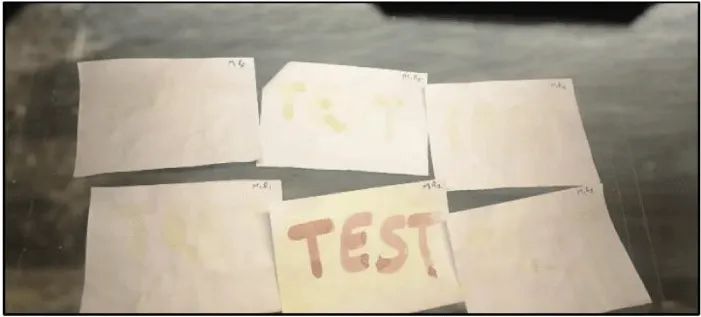
Figure 1: Development of Copper Sulphate Invisible Ink on White Paper Under Visible Light.
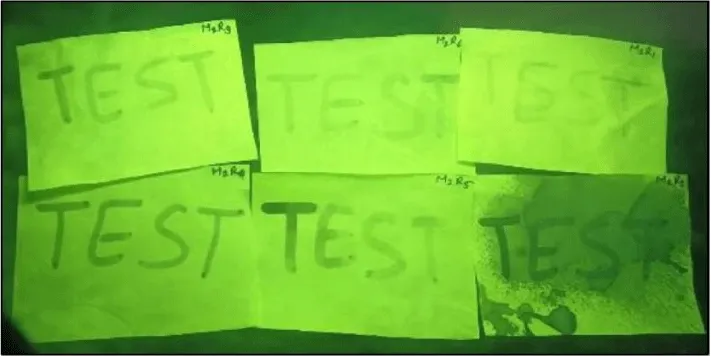
Figure 2: UV Visualization of Copper Sulphate Invisible Ink on Lime Green Paper.
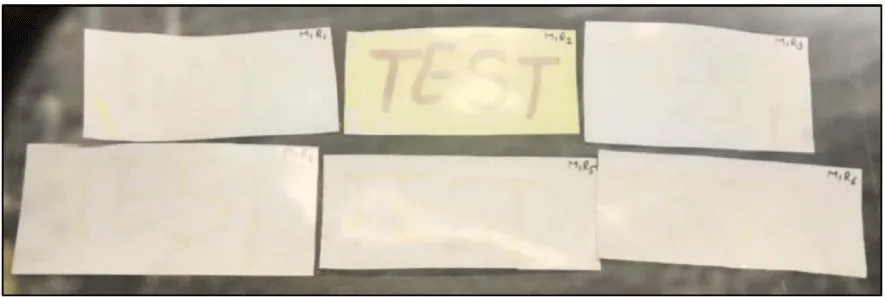
Figure 3: Development of Copper Sulphate Invisible Ink on Glossy paper Under Visible Light.
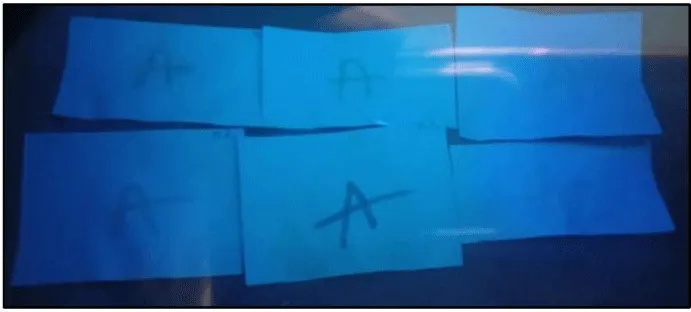
Figure 4: UV Visualization of Copper Sulphate Invisible Ink on Skin colour paper.
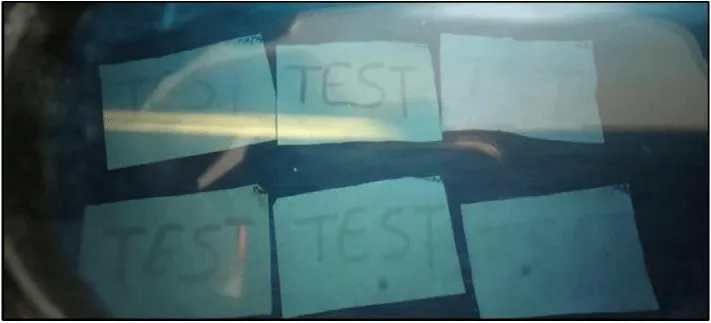
Figure 5: UV visualization of copper sulphate ink on yellow paper.
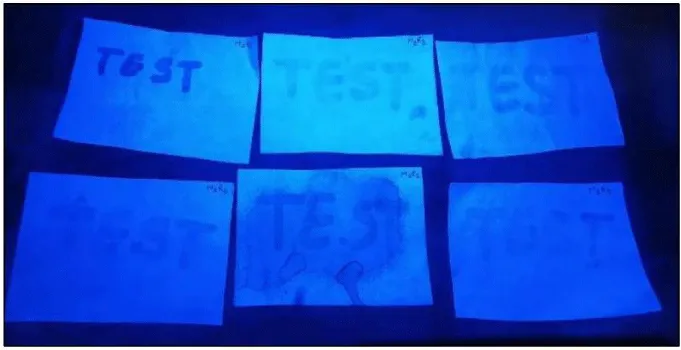
Figure 6: UV Visualization of Ferrous Sulphate on White paper.

Figure 7: UV Visualization of Ferrous Sulphate on Glossy paper.
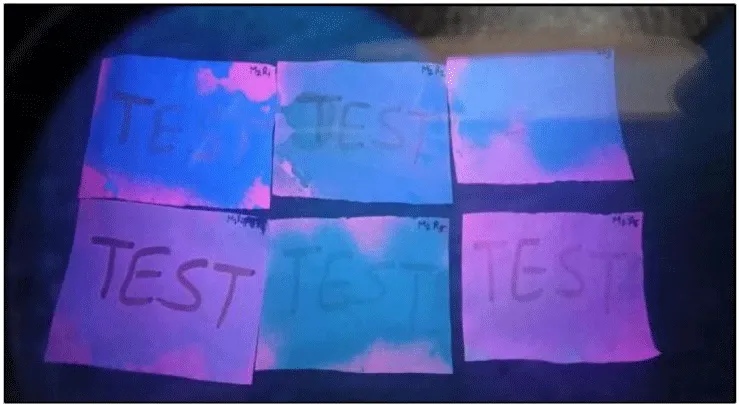
Figure 8: UV Visualization of Ferrous Sulphate on Pink paper.
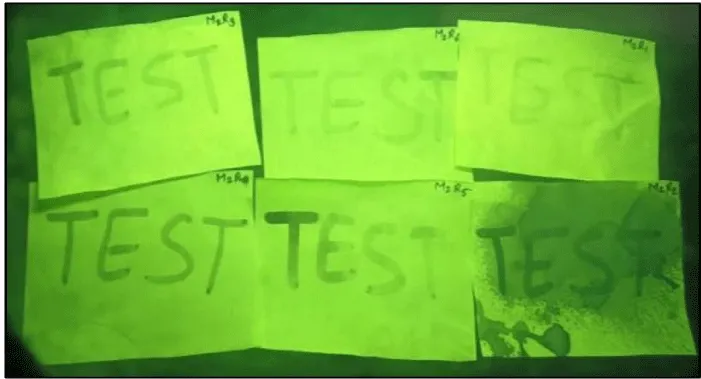
Figure 9: UV Visualization of Ferrous Sulphate on Lime green under UV light.
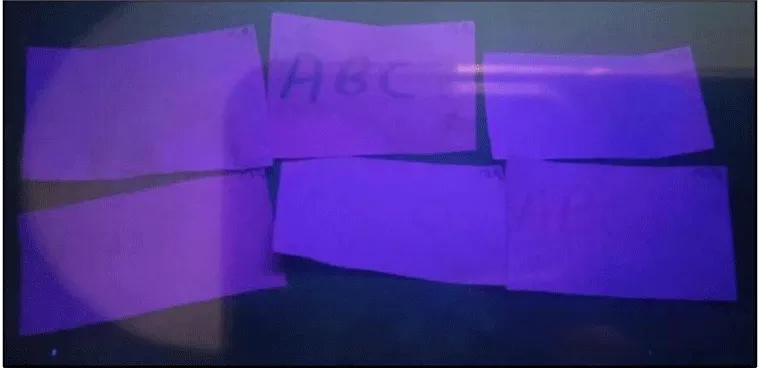
Figure 10: UV visualization of ferrous sulphate on Red paper.
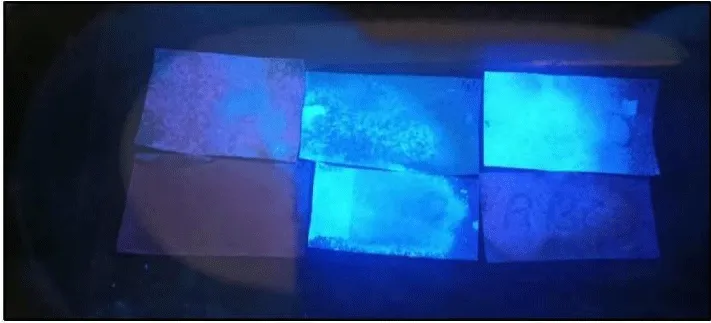
Figure 11: UV Visualization of Zinc Sulphate on Brown paper.
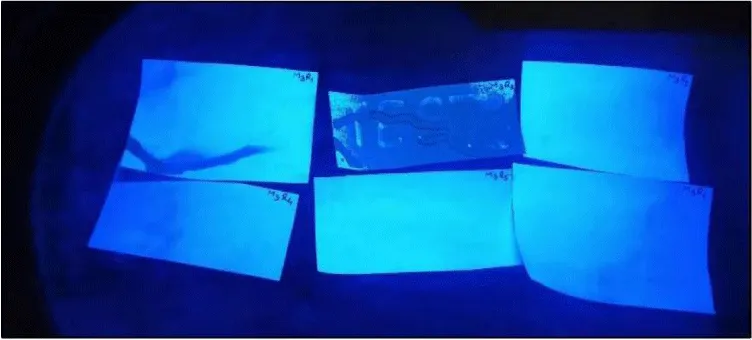
Figure 12: UV Visualization of Zinc Sulphate on Glossy paper.
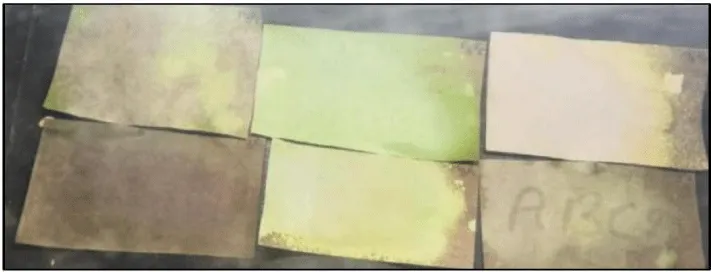
Figure 13: Development of zinc sulphate invisible ink on brown paper under visible light.
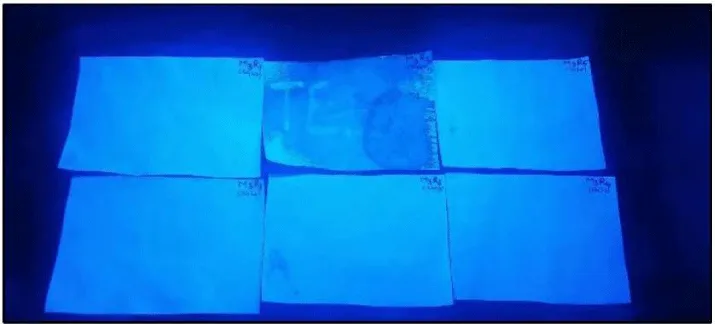
Figure 14: UV visualization of zinc sulphate on skin paper.
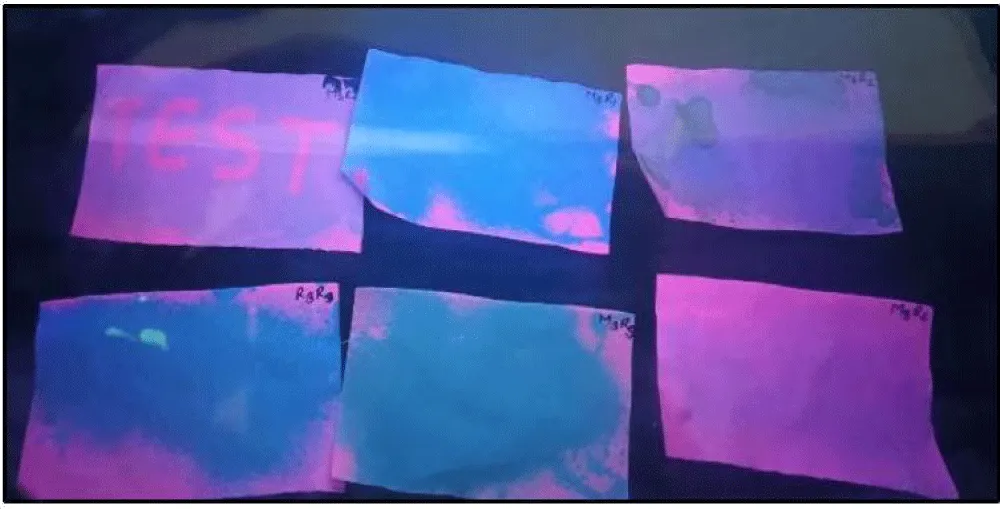
Figure 15: UV visualization of zinc sulphate on Pink paper.
| Table 2: Observation of Ferrous Sulphate Invisible Ink on Different Paper Types | ||||||
| No. | Ink | Reagent | Paper types | Colour Developed | Visibility | UV Response |
| 1 | Ferrous Sulphate | R1 | White | Light yellow | Visible after drying | Fluorescence Observed |
| R2 | Light yellow | Visible after drying | Fluorescence Observed | |||
| R3 | Light yellow | Visible after drying | Fluorescence Observed | |||
| R4 | Light yellow | Visible after drying | Fluorescence Observed | |||
| R5 | Light yellow | Visible after drying | Fluorescence Observed | |||
| R6 | Light yellow | Visible after drying | Fluorescence Observed | |||
| 2 | R1 | Pink | Light yellow | Immediately visible | Fluorescence Observed | |
| R2 | Light red | Immediately visible | Fluorescence Observed | |||
| R3 | Light yellow | Slightly visible | Fluorescence Observed | |||
| R4 | Red | Immediately visible | Fluorescence Observed | |||
| R5 | Light yellow | Immediately visible | Fluorescence Observed | |||
| R6 | Red | Slightly | Fluorescence | |||
| 3 | visible | Observed | ||||
| R1 | Orange | Not visible | No Fluorescence | |||
| R2 | Black | Immediately visible | Fluorescence Observed | |||
| R3 | Not Identified | Not visible | No Fluorescence | |||
| R4 | Reddish brownish | Immediately visible | Fluorescence Observed | |||
| R5 | Not Identified | Not visible | No Fluorescence | |||
| R6 | Not identified | Immediately visible | Fluorescence Observed | |||
| 4 | R1 | Lime green | Not identified | Not visible | Blue Fluorescence | |
| R2 | Green | Immediately visible | Fluorescence Observed | |||
| R3 | Not identified | Slightly visible | Fluorescence Observed | |||
| R4 | Red | Immediately visible | Fluorescence Observed | |||
| R5 | Red | Slightly visible | Fluorescence Observed | |||
| R6 | Light red | Slightly visible | Fluorescence Observed | |||
| 5 | R1 | Yellow | Not identified | Slightly visible | Fluorescence Observed | |
| R2 | Green | Immediately | Fluorescence | |||
| R3 | visible | Observed | ||||
| Not identified | Slightly visible | Fluorescence Observed | ||||
| red | Immediately visible | Fluorescence Observed | ||||
| R5 | Not identified | Slightly visible | Fluorescence Observed | |||
| R6 | Not identified | Slightly visible | Fluorescence Observed | |||
| 6 | R1 | Glossy | Not identified | Not visible | Blue Fluorescence | |
| R2 | Glossy | Blue | Immediately visible | Blue Fluorescence | ||
| R3 |
|
Not identified | Not visible | Blue Fluorescence | ||
| R4 | Faint reddish | Slightly visible | Blue Fluorescence | |||
| R5 | Not identified | Slightly visible | Blue Fluorescence | |||
| R6 | Not identified | Slightly visible | Blue Fluorescence | |||
| 7 | R1 | green | Not identified | Not visible | Blue Fluorescence | |
| R2 | Not identified | Not visible | Blue Fluorescence | |||
| R3 | Not identified | Not visible | Blue Fluorescence | |||
| R4 | Not | Not visible | Blue | |||
| 8 | identified Not identified | Fluorescence Blue Fluorescence | ||||
| R6 | Not identified | Not visible | Blue Fluorescence | |||
| R1 | Sky blue blue | Not identified | Slightly visible | Fluorescence Observed | ||
| R2 | Light black | Immediately visible | Fluorescence Observed | |||
| R3 | Not identified | Slightly visible | Fluorescence Observed | |||
| R4 | Faint orange | Immediately visible | Fluorescence Observed | |||
| R5 | Faint yellow | Slightly visible | Fluorescence Observed | |||
| R6 | Faint yellow | Slightly visible | Fluorescence Observed | |||
| 9 | R1 | Not Identified | Not visible | No Fluorescence | ||
| R2 | Reddish brownish | Slightly visible | Blue Fluorescence | |||
| R3 | Not Identified | Not visible | No Fluorescence | |||
| R4 | Not Identified | Not visible | No Fluorescence | |||
| R5 | Not identified | Slightly visible | Blue Fluorescence | |||
| R6 | Not | Slightly | Blue | |||
| identified | visible | Fluorescence | ||||
| R1 | Brown | Faint yellow | Immediately visible | Fluorescence Observed | ||
| R2 | Reddish brownish | Immediately visible | Fluorescence Observed | |||
| R3 | Faint Green | Immediately visible | Fluorescence Observed | |||
| R4 | Reddish brownish | Immediately visible | Fluorescence Observed | |||
| R5 | Reddish brownish | Slightly visible | Fluorescence Observed | |||
| R6 | Reddish brownish | Slightly visible | Fluorescence Observed | |||
| 11 | R1 | Navy Blue | Faint yellow | Slightly visible | Fluorescence Observed | |
| R2 | Faint yellow | Slightly visible | Fluorescence Observed | |||
| R3 | Faint yellow | Slightly visible | Fluorescence Observed | |||
| R4 | Faint yellow | Slightly visible | Fluorescence Observed | |||
| R5 | Faint yellow | Slightly visible | Fluorescence Observed | |||
| R6 | Faint yellow | Slightly visible | Fluorescence Observed | |||
| 12 | R1 | Skin colour | Red | Immediately visible | Fluorescence Observed | |
| R2 | Blue | Immediately | Fluorescence | |||
| visible | Observed | |||||
| R3 | Faint red | Slightly visible | Fluorescence Observed | |||
| R4 | Faint black | Immediately visible | Fluorescence Observed | |||
| R5 | Not identified | Slightly visible | Fluorescence Observed | |||
| R6 | Faint black | Immediately visible | Fluorescence Observed | |||
| Table 3: Observation of Zinc Sulphate Invisible Ink on Different Paper Types. | ||||||
| No. | Ink | Reagent | Paper types | Colour Developed | Visibility | UV Response |
| 1 | Zinc Sulphate | R1 | White | Not Identified | Not visible | No Fluorescence |
| R2 | Not Identified | Not visible | Blue Fluorescence | |||
| R3 | Not Identified | Not visible | No Fluorescence | |||
| R4 | Not Identified | Not visible | No Fluorescence | |||
| R5 | Not Identified | Not visible | No Fluorescence | |||
| R6 | Not Identified | Not visible | No Fluorescence | |||
| 2 | R1 | Pink | Not Identified | Not visible | No Fluorescence | |
| R2 | Not Identified | Not visible | No Fluorescence | |||
| R3 | Not Identified | Not visible | No Fluorescence | |||
| R4 | Pink | Immediately visible | Fluorescence Observed | |||
| R5 | Not Identified | Not visible | No Fluorescence | |||
| R6 | Not Identified | Not visible | No Fluorescence | |||
| 3 | R1 | Orange | Not Identified | Not visible | No Fluorescence | |
| R2 | Not Identified | Not visible | No Fluorescence | |||
| R3 | Not Identified | Not visible | No Fluorescence | |||
| R4 | Not Identified | Not visible | No Fluorescence | |||
| R5 | Not Identified | Not visible | No Fluorescence | |||
| R6 | Not Identified | Not visible | No Fluorescence | |||
| 4 | R1 | Lime green | Not Identified | Not visible | No Fluorescence | |
| R2 | Not Identified | Not visible | No Fluorescence | |||
| R3 | Not Identified | Not visible | No Fluorescence | |||
| R4 | Not Identified | Not visible | No Fluorescence | |||
| R5 | Not Identified | Not visible | No Fluorescence | |||
| R6 | Not Identified | Not visible | No Fluorescence | |||
| 5 | R1 | Yellow | Not Identified | Not visible | No Fluorescence | |
| R2 | Not Identified | Not visible | No Fluorescence | |||
| R3 | Not Identified | Not visible | No Fluorescence | |||
| R4 | Not Identified | Not visible | No Fluorescence | |||
| R5 | Not Identified | Not visible | No Fluorescence | |||
| R6 | Not Identified | Not visible | No Fluorescence | |||
| 6 | R1 | Glossy paper | Not Identified | Not visible | No Fluorescence | |
| R2 | Yellow | Immediately visible | Fluorescence Observed | |||
| R3 | Not Identified | Not visible | No Fluorescence | |||
| R4 | Not Identified | Not visible | No Fluorescence | |||
| R5 | Not Identified | Not visible | No Fluorescence | |||
| R6 | Not Identified | Not visible | No Fluorescence | |||
| 7 | R1 | Not Identified | Not visible | No Fluorescence | ||
| R2 | Not Identified | Not visible | No Fluorescence | |||
| R3 | Not Identified | Not visible | No Fluorescence | |||
| R4 | Not Identified | Not visible | No Fluorescence | |||
| R5 | Not | Not visible | No Fluorescence | |||
| R6 | Not Identified | Not visible | No Fluorescence | |||
| 8 | R1 | Sky blue | Not Identified | Not visible | No Fluorescence | |
| R2 | Not Identified | Not visible | No Fluorescence | |||
| R3 | Not Identified | Not visible | No Fluorescence | |||
| R4 | Not Identified | Not visible | No Fluorescence | |||
| R5 | Not Identified | Not visible | No Fluorescence | |||
| R6 | Not Identified | Not visible | No Fluorescence | |||
| 9 | R1 | Not Identified | Not visible | No Fluorescence | ||
| R2 | Not Identified | Not visible | No Fluorescence | |||
| R3 | Not Identified | Not visible | No Fluorescence | |||
| R4 | Not Identified | Not visible | No Fluorescence | |||
| R5 | Not Identified | Not visible | No Fluorescence | |||
| R6 | Not Identified | Not visible | No Fluorescence | |||
| 10 | R1 | Brown | Not Identified | Not visible | No Fluorescence | |
| R2 | Not Identified | Immediately visible | Fluorescence Observed | |||
| R3 | Not Identified | Not visible | No Fluorescence | |||
| R4 | Not Identified | Not visible | No Fluorescence | |||
| R5 | Not Identified | Not visible | No Fluorescence | |||
| R6 | Not Identified | Not visible | No Fluorescence | |||
| 11 | R1 | Navy Blue | Not Identified | Not visible | No Fluorescence | |
| R2 | Not Identified | Not visible | No Fluorescence | |||
| R3 | Not Identified | Not visible | No Fluorescence | |||
| R4 | Not Identified | Not visible | No Fluorescence | |||
| R5 | Not Identified | Not visible | No Fluorescence | |||
| R6 | Not Identified | Not visible | No Fluorescence | |||
| 12 | R1 | Skin colour | Not Identified | Not visible | No Fluorescence | |
| R2 | Not Identified | Not visible | No Fluorescence | |||
| R3 | Not Identified | Not visible | No Fluorescence | |||
| R4 | Not Identified | Not visible | No Fluorescence | |||
| R5 | Not Identified | Not visible | No Fluorescence | |||
| R6 | Not Identified | Not visible | No Fluorescence | |||
The results show that copper sulphate invisible ink is good for forensic document examination purposes as it gave good uniform colour-developing reactions with the different types of paper and was positive with most of the chemical reagents chosen.It can change color immediately it can become luminescent in UV light and it can be seen as writing after drying which confirms its applicability to the detection of latent writing in forensic uses.
The use of the ferrous sulphate invisible ink was moderately effective Although it wasn't all that impressive in normal light its UV detection of latent print made a difference.It is seen from these observations that the ferrous sulphate invisible ink can be successfully used in the instances where UV examination facilities are available especially in documents where the latent writing is not easily discernible under normal lighting.
The activity of the invisible ink zinc sulphate was comparatively low when compared with the other two metal salts However Potassium ferrocyanide applied as visualization reagent was the most successful in terms of compatibility especially on glossy paper in which the yellow colour is developed instantly. Moreover under the ultraviolet light the latent writing on both the white paper and the brown paper were enhanced. Though zinc sulphates showed inferior overall performance it should have potentiality for latent writing detection if used in combination with potassium ferrocyanide and UV examination. From the results of the present study, it is clear that the efficacy of the metal salt based invisible inks is greatly dependent upon the chemical properties of the metal ions, the visualization reagent used and the paper type of the media. This is the case for all three of the metal salts.
Results of the current research indicated that the effectiveness of the metal salt based invisible inks depends on the chemical properties of the metal ion, visualization agent used, and paper substrate. Copper sulphate showed better visualizing performance than any of the other metals' salts in this study, producing different colour developing even for all of the visualization agents tested. This improvement in performance may be explained by the ease with which copper ions tend to form complexes with different chemical reagents in which stable, easily distinguished colours are formed. The results are similar to that reported in past studies [3,4] on metal ion-based invisible inks which exhibited outstanding visualization characteristic and thus were chosen as the wisely suited candidate for forensic document examination and security printing application.
The result of the Ferrous sulphate was fair compared to both CuSO4. The developed writing was not always discernible upon all illumination during the normal circumstances, however it was also seen that with the illumination of long-wave UV, the fluorescence between the different layers enhance the detecting of the latent writing. This discovery is significant with regard to other sources of light in examinatory work of the forensics. In a forensic laboratory, ultraviolet light is regularly used to find erased text or hidden writing, and also to spot alterations on documents which cannot be seen by "white" light. Hence, these present results reaffirm the applicability of the ferrous sulphate invisible ink for some applications, where the facility of the UV examination is available [7,8].
Potassium ferrocyanide is the most compatible reagent among the visualization reagents to zinc sulphate invisible ink. Using zinc sulphate generally resulted in a less intense colour, although the presence of yellow colour on glossy paper surface suggest a detectable colour under UV light, this means that the choice of reagent is important for determining the efficacy of invisible ink systems. These observations indicate that the performance of less active metal salts for forensic use can be improved by optimizing reagents' composition.
Another factor, observed during the present study, was the influence of paper substrate. As far as contrast, white paper offered the best results due to the uniform background, while with coloured papers (pink and brown) it was slightly less pronounced between the colour and the paper surface. However, copper sulphate was still very evident on all substrates tested. Glossy paper was found to show unique behavior in the reagents seen because it absorbs less and the surface is smoother with the result that the coloration could be observed more quickly in the case of some of the reagent combinations. The results highlight the need to take paper properties and the reagents' chemistry aspects into account in the forensic analysis of questioned documents.
In forensic aspects, the developed metal salt based invisible inks are very precious and useful. They can be used for confidential communications, deciphering important documents, antfordalisation, security printing, analysis of questioned documents, educational demonstration and laboratory training. These invisible inks can also be used to securely store information or verify documents because specific chemicals or ultraviolet light is required to reveal their content.
Further the present study exhibits some advantages of the metal salt based invisible ink. The materials used are cheap, readily available, easily prepared and not so detrimental as many security ink commercial materials. Moreover, expensive instrumentation and complicated synthesis are not required for the preparation procedure, and hence these invisible inks could be applied in routine forensic laboratory uses or academic research. However, some considerations should be noted about these positive results. Only three metal salts and a select few visualization reagents were assessed and on only selected paper substrates. No investigation was done on the environmental factors like prolonged storage, humidity, temperature, ageing and exposure to sun. Besides, quantitative colour measurement and long term stability studies could not be done as such in the present work. However. more research must be carried out using other metal salts better formulation of the reagents faster ageing processes and using more sophisticated instrumental analysis techniques in order to better adapt the use of these invisible ink systems to actual casework scenarios.
Some possible further studies are to incorporate the fluorescent nanomaterials rare earth metal ions photochromic compounds and environmentally friendly formulations into them for enhanced sensitivity durability and security. These advances could enhance the use of invisible inks for secure communication smart packaging anti counterfeiting and in forensic science [7,9].
Copper sulphate always showed better performance than other materials in terms of demonstrating a clear colour development under the influence of all the visualization reagents used. This improvement in performance may be due to the fact that Copper ions are easily susceptible to complexation reactions with different chemical reagents which provides stable coloured complexes which are easily distinguishable In a fore mentioned study Kamyshny et al., [3] revealed that the availability of visible property and good level of visualization was observed for metal ion based invisible inks which were potentially usable in forensic document examination and security printing. Also similar observation was reported in previous studies where metal ion based invisible inks showed excellent visualization characteristics which were suitable for forensic document examination and security printing [4].
Ferrous sulphates proved to give medium performance when compared to copper sulphates. The developed writing was not at all times clearly seen in daylight but the fluorescence observed under long wave ultraviolet light was of great help in detection of latent writing.This discovery is of significance in the field of forensic document examination for use of alternate lighting sources.Ultraviolet illumination is often used routinely in the forensic lab to search for written content under the visible light that may have been obliterated or hidden from the naked eye.Thus the current results suggest that ferrous sulphate invisible ink can be utilized in cases where an ultraviolet examination setup is present [7,8].
Potassium ferrocyanide had the largest compatibility with zinc sulphate invisible ink among the visualization reagents.As with other metal salts zinc sulphate tends to give less intense colour but the fact that a visible yellow was produced on glossy paper and that UV visualisation is also greater indicates reagent selection is a key factor in determining effectiveness of invisible ink systems.These considerations imply that the performance of relatively less reactive salts of the metals for forensic purpose can be significantly enhanced by optimisation of reagent composition.
Another important observation made for the present study was that of the influence of paper substrate.White paper in general gave the greatest visibility due to its good uncoloured background while coloured papers such as pink and brown slightly decreased the contrast between the colour developed and the paper surface.However copper sulfate solution was still easily identified on all substrates analysed.Glossy paper had another property as a result of its smooth surface and low absorbency; certain reagent combinations resulted in rapid visualization.Our findings supports the need to consider paper properties and reagent chemistry in forensic examination of questioned documents.
Forensic aspects of well-developed invisible inks using metal salt-based chemicals have great practical significance.This kind of system can be used in confidential communications during the verification of important documents anti-counterfeiting applications security printing in questioned document examination and in education and laboratory training.Since these inks need particular chemical ingredients or ultraviolet light to uncover they can also be employed in secure data storage and document verification [5,6].
The present study also shows some key benefits of metal salt inks as invisible inks.The materials are easily obtained in inexpensive quantities and are easibly prepared without harming the environment compared to many of the commercially available security inks. Moreover the preparation protocol is simple and no complex equipment or synthesis is needed so the invisible inks can be applied in the routine forensic laboratory and in academic research.
However there are some drawbacks to this promising research.It has been tested with only three metal salts and select paper substrates with the limited number of visualization reagents.Environmental influences such as long storage humidity temperature exposure to sunshine and ageing were not studied.Moreover quantitative colour measurements and long time stability studies were not in the scope of the present work. Thus more studies are desired with other metal salts optimizing the reagent compositions performing aging experiments under accelerated conditions and using more powerful instrumental techniques to enhance the usefulness of these invisible ink systems for actual scene forensic work.
The future research can also involve the integration of fluorescent nanomaterials rare earth metal ions photochromic compounds and environmentally friendly formulations for enhanced sensitivity durability and security.These innovations could enhance the use of invisible inks in a variety of fields such as forensic science secure communication smart packaging and advanced anti-counterfeiting technologies [7,9-27].
In this study, we investigated the use of different chemical reagents and UV examination methods to assess the usefulness of copper, iron, and zinc as invisible ink (non-registered trademarks). The results showed that copper was the best performing of the three invisible inks with respect to generating colour development and clear visibility on the various paper types tested. Copper invisible ink positively reacted with all chemical reagents and could be visualised successfully via the following two methods: (1) by using the normal light; and (2) via long-wave ultraviolet (UV) light (UV) to stimulate the development of visible colour (fluorescence) and colour visibility of the original written message. Ferrous was moderately effective as an invisible ink, as both the writing and the fluorescing colour could not always be seen using normal lighting conditions (dark blue); however, fluorescence from a long-wavelength source could be detected on many occasions when using long-wave ultraviolet light. The performance of the ferrous invisible ink was affected positively or negatively by the paper type and by the reagent/licensing supplier. Zinc was the least effective invisible ink and did not produce much colour development on most of the paper substrates used in the study. In contrast to the other chemical agents tested, potassium ferrocyanide exhibited superior results when using zinc sulphate ink. There was significant yellow colour development on glossy paper with potassium ferrocyanide although no visible results were produced on the white and brown paper unless viewed through UV light, therefore latent writing may be found on all the papers once exposed under UV light but not visible when examined with normal lighting conditions. These results indicate how crucial both chemical reagents and ultraviolet examination are when detecting and viewing invisible writing. Copper sulphate was found to be the most effective of the three different metal salt inks evaluated, followed by ferrous sulphate, and zinc sulphate being the least effective. This study gives forensic document examiners an increased knowledge base as well as potentially improves the methodology used to detect invisible writing on different types of paper substrates.
- Abd-ElZaher MAA. Different types of inks having certain medicolegal importance: deciphering the faded and physically erased handwriting. Egypt J Forensic Sci. 2014;4(2):39-44. Available from: https://dx.doi.org/10.1016/j.ejfs.2013.09.002.
- Fatima F. Forensic examination and identification of writing inks on documents. LGU Int J Electron Crime Investig. 2020;4(3).
- Kamyshny A, Steinke J, Magdassi S. Metal-based inkjet inks for printed electronics. Open Appl Phys J. 2014;7:19-36.
- Sadhu S, Dubey A. Visualisation of secret handwriting by physical and chemical method. Int J Multidiscip Res. 2024;6(1):IJFMR240113848.
- Razavi B, Roghani-Mamaqani H, Salami-Kalajahi M. Development of highly sensitive metal-ion chemosensor and key-lock anticounterfeiting technology based on oxazolidine. Sci Rep. 2022;12:1079. Available from: https://dx.doi.org/10.1038/s41598-022-05098-x.
- Jain RK, Anand PJ, Sunil D, Bhagavath P, Vatti AK, Prasad MKS, et al. Fluorene-vanillin hybrid: a multifunctional fluorophore for latent fingerprint detection and sustainable offset security ink development. Prog Org Coat. 2025;207:109425. Available from: https://dx.doi.org/10.1016/j.porgcoat.2025.109425
- Mishra SR, Mandal T, Singh V. Development of cost-effective fluorescent carbon nanoparticles as security ink for anticounterfeiting and fingerprint visualization. Nanoscale Adv. 2025. Available from: https://dx.doi.org/10.1039/D5NA00370A.
- Cieśla R. Non-invasive forensic examination of inscriptions in a historical document as an attempt to evaluate the diversity of the commercial offer of inks. Int J Criminalistics Sci. 2024;3(16). Available from: https://dx.doi.org/10.36868/IJCS.2024.03.16.
- Verma P, Ujjainia P, Moza B, Mukherjee D. Nanoparticles as silent witnesses: significance, challenges and ethical considerations in forensic analysis. Rasayan J Chem. 2024;17(1):297-305. Available from: https://dx.doi.org/10.31788/RJC.2024.1718665.
- Bardi MAG, Auras R, Brocardo Machado LD, Brocardo LD. Interaction of UV/EB-cured print inks applied to a compostable polymer blend. RadTech Rep. 2014;(4):24-31.
- Buzzini P, Massonnet G. The analysis of colored inks by Raman spectroscopy in forensic science. J Raman Spectrosc. 2015;46(1):70-80. Available from: https://dx.doi.org/10.1002/jrs.4605.
- Causin V, Marega C, Schiavone S, Marigo A, Favretto D. Forensic differentiation of writing inks by UV-Vis spectroscopy and chemometric analysis. Forensic Sci Int. 2010;197(1-3):1-8.
- Chen HS, Meng HH, Cheng KC. A survey of methods used for the identification and characterization of inks. J Forensic Sci. 2002;47(3):565-574.
- Garai B, Mallick A, Banerjee R. Photochromic metal-organic frameworks for inkless and erasable printing. Chem Sci. 2016;7(3):2195-2200. Available from: https://dx.doi.org/10.1039/C5SC04450B.
- Irie M, Fukaminato T, Matsuda K, Kobatake S. Photochromism of diarylethene molecules and crystals: memories, switches, and actuators. Chem Rev. 2014;114(24):12174-12277. Available from: https://dx.doi.org/10.1021/cr500249p.
- Macrakis K. The hidden past of invisible ink. Am Sci. 2014;102(3):198-205.
- Ma Y, She P, Yi K, Zhang S, Li W, Liu Q, et al. Dynamic metal-ligand coordination for multicolour and water-jet rewritable paper. Nat Commun. 2018;9:3. Available from: https://dx.doi.org/10.1038/s41467-017-02452-w.
- Mishra JK, Francis V. Investigations on the development and characterization of liquid silicone rubber/TiO2 composite ink for additive manufacturing via direct ink writing technique. Eng Res Express. 2026;8(8). Available from: https://dx.doi.org/10.1088/2631-8695/ae5ece.
- Rajagopal S. The forensic analysis of skin-safe stamp pad inks [master's thesis]. New York (NY): John Jay College of Criminal Justice, City University of New York; 2019. Publication No. 13895653.
- Research Journal of Forensic Sciences. Forensic examination of disappearing ink and its detection methods. Res J Forensic Sci. 2023;11(1):1-5.
- Sowmyya T. Potential forensic applications of carbon nanodots. J Phys Conf Ser. 2023;2603:012057. Available from: https://dx.doi.org/10.1088/1742-6596/2603/1/012057.
- Sylvester A. Digital invisible ink writing: imperceptibility & security enhancement technique-steganography (focus on LSB technique, MD5 128 bits & AES 256 bits algorithm) [bachelor's thesis]. Estonia: Estonian Entrepreneurship University of Applied Sciences; 2021.
- Taufeeq M, Ameen A, Singh N, Nazeer K, Yadav E, Parveen R, et al. Forensic examination of chemically altered documents: efficacy of acetone, ethanol, DMF and hydrogen peroxide on common writing inks. Bull Chem Anal. 2026;26(1). Available from: https://dx.doi.org/10.51470/bca.2026.26.1.865.
- Tian H, Yang S. Recent progresses on diarylethene based photochromic switches. Chem Soc Rev. 2004;33(2):85-97. Available from: https://dx.doi.org/10.1039/B302356G.
- Wisniak J. Jean Hellot: a pioneer of chemical technology. Rev CENIC Cienc Quim. 2009;40(2):111-121.
- Zhang C, Wang B, Li W, Huang S, Kong L, Li Z, et al. Conversion of invisible metal-organic frameworks to luminescent perovskite nanocrystals for confidential information encryption and decryption. Nat Commun. 2017;8:1138. Available from: https://dx.doi.org/10.1038/s41467-017-01248-2.
- Zięba-Palus J. Seeing the invisible-criminalistic microtraces. Probl Forensic Sci. 2014;100:307-317.