
More Information
Submitted: July 15, 2026 | Accepted: July 17, 2026 | Published: July 20, 2026
Citation: Pandey N, Aggarwal B. DNA Phenotyping: Predicting Physical Characteristics from Genetic Material. J Forensic Sci Res. 2026; 10(2): 78-87. Available from:
https://dx.doi.org/10.29328/journal.jfsr.1001119
DOI: 10.29328/journal.jfsr.1001119
Copyright license: © 2026 Pandey N, et al. This is an open access article distributed under the Creative Commons Attribution License, which permits unrestricted use, distribution, and reproduction in any medium, provided the original work is properly cited.

DNA Phenotyping: Predicting Physical Characteristics from Genetic Material
Nyasa Pandey* and Bhoomi Aggarwal*
Department of Forensic Sciences, Vivekananda Global University, Jaipur, Rajasthan, India
*Corresponding author: Nyasa Pandey, Department of Forensic Sciences, Vivekananda Global University, Jaipur, Rajasthan, India, Email: [email protected]
Bhoomi Aggarwal, Department of Forensic Sciences, Vivekananda Global University, Jaipur, Rajasthan, India, Email: [email protected]
DNA phenotyping is an advanced method in forensic science that has emerged and enables the prediction of externally visible characteristics (EVCs) from biological material. DNA phenotyping employs markers such as single nucleotide polymorphisms (SNPs) to predict eye colour, hair colour, skin pigmentation and biogeographical origin. Classical DNA profiling, aimed at individual identification, is based on short tandem repeats (STRs). Recent advances in next-generation sequencing (NGS), epigenetic analysis and analytics have considerably improved the accuracy and range of phenotypic predictions even with limited or degraded DNA material. This has proven to be quite useful in criminal investigations, missing persons and catastrophe victim identification without any suspect or reference profile. However, the accuracy of DNA phenotyping is limited by complex gene–environment interactions and the probabilistic character of the approach for some traits, e.g. facial form. Its widespread use is severely limited by ethical, legal and cultural challenges, such as privacy concerns and the potential for misuse. This review emphasises the importance of DNA phenotyping as an additional tool in current forensic investigations and describes its principles, methodology, applications, limitations and prospects. Forensic Genetics DNA Phenotyping Single Nucleotide Polymorphisms (SNPs) Externally Visible Characteristics (EVCs) Next Generation Sequencing (NGS) Epigenetics Forensic Identification Bioinformatics.
Forensic DNA phenotyping (FDP) is a new issue in forensic science that aims to predict the physical and biological characteristics of a person from the genetic information. If a suspect is not available, DNA phenotyping might give the inquiry leads about the outwardly observable qualities of a person. It is used to identify persons by matching their DNA profile against existing references or databases. Traditional DNA profiling Especially beneficial in cases where biological evidence does not correspond with any profiles in modern DNA databases. DNA phenotyping is based on the development of molecular genetics and genomics, notably the discovery of the genetic basis of several observable phenotypic features of the human body. Initially, forensic DNA analysis relied largely on identification by short tandem repeat (STR). But now, thanks to sophisticated technology, you can analyse single nucleotide polymorphisms (SNPs) and other genetic markers to make an educated guess about things like eye colour, hair colour, skin tone and even ancestry. But those advances have converted forensic genetics from an identification tool to a prediction tool. The concept of linking genetic information with phenotypic features is based on the earliest studies of inheritance patterns in genetics, but has been widely applied in forensic research in the last 20 years. The advent of high-throughput sequencing technologies and sophisticated bioinformatics tools has greatly enhanced the accuracy and robustness of trait prediction models. Thus, DNA phenotyping provides an important extra tool to forensic investigations, especially in difficult situations such as catastrophic disasters, missing persons and unknown perpetrators. DNA phenotyping is an increasingly important forensic investigative tool for generating investigative leads in complex cases. It has been particularly beneficial in instances where traditional identification techniques may not be possible, such as cold cases, unidentified human remains and catastrophic tragedies. Information on the likely physical appearance and biogeographical ancestry of the suspect can be used to prioritise leads and narrow the field of prospective suspects. Law enforcement has occasionally utilised composite sketches based on the DNA predictions to aid in the identification of unknowns. In modern criminal investigations, DNA phenotyping is not an absolute proof, but a technique of intelligence gathering. It helps to reduce the number of suspects, guides the conduct of investigations and offers visual evidence when other approaches are unable to. There are several scientific, ethical and legal problems to be addressed before the technology may be used responsibly. DNA phenotyping is a quantum leap for forensic biology, as it is the first time genetic information can be tied to physical identity. The use of DNA phenotyping also raises further important ethical, legal and societal challenges. There are questions to be raised about genetic privacy, about the misuse of data, about the potential for reinforcing racial or ethnic stereotypes. The legal regimes concerning the employment of this technology are diverse in different nations. This implies differences in cultural attitudes to forensic practice and genetic surveillance.
Genetics and physical characteristics
The genetic blueprint, DNA genes are DNA that tell what things look like. Genes carry information for making proteins that provide shape, colour, and biological function. The alleles function (gene variants): variance in genes leads to variance in attributes. For instance, the alleles could be responsible for different hair or eye hues. These are called single nucleotide polymorphisms, or SNPs.
Key parameters in DNA phenotyping
Minor modifications in a base pair can have a big impact on physical traits. Some SNPs have been associated with pigmentation features. In expression research, not all genes are always “on.” The degree to which a trait is expressed is the level of expression of a trait is controlled by regulatory elements of DNA. Inheritance of many genes: most physical features are affected by more than one gene. Characteristics such as height, skin colour and facial features are the consequence of several genes working together. A single gene can affect multiple features. For example, a gene regulating pigment can change the colour of your skin and eyes. Epistasis: gene interaction. Genes can interact and alter the characteristic expression. One gene may boost or decrease the activity of another gene. Epigenetics: DNA methylation is a chemical modification that alters gene expression, but not the DNA sequence. Useful for predicting a variety of age- and environment-related features.
Single Nucleotide Polymorphisms (SNPs) role
- Genetic markers for phenotypic prediction – primary
- The most common marker used in DNA phenotyping is single nucleotide polymorphisms (SNPs) directly related to the genes encoding the physical attributes.
- Single Nucleotide Variation (SNV) in DNA sequence indicates a change in one of the four bases (A, T, C or G) at a specific position in the genome.
Relation to externally observable features (EOCs)
- Some SNPs have been associated with traits such as eye colour, hair colour and skin colour.
- The human genome's richness
- The genome contains millions of SNPs and therefore a lot of genetic information.
- Stable and appropriate for deteriorated samples
- SNPs are brief and thus easier to analyse in degraded or limited forensic materials.
- Capable of inferring descent
- The biogeographical origin of a population may be inferred from certain SNP patterns.
- Polygenic trait analysis
- Prediction model development
Statistical models then use the SNP data to predict the probability of various traits.
Forensic Kits
- Commercial tests (e.g., the HIrisPlex system) predict eye and hair colour using specific panels of SNPs.
- Compatibility with the newest technology
- Current techniques, e.g. Next-Generation Sequencing (NGS), allow for SNP analysis.
- Lower mutation rate than for STRs.
- It stabilises inheritance patterns over time.
Limitations of predictive accuracy
The contribution of individual SNPs is modest; hence, a large number of SNPs have to be analysed to provide robust prediction.
Polygenic and complex inheritance of characteristics
Polygenic inheritance occurs when many genes influence one trait, and each gene contributes a small effect to the phenotype. Most apparent traits (e.g. skin colour, height, facial traits and hair texture) are polygenic in DNA phenotyping, i.e. they cannot be properly predicted from the study of a single gene or genetic marker. Instead, those traits are the product of the combined action of several genetic variants, typically involving many Single Nucleotide Polymorphisms (SNPs) spread throughout the genome. However, trait prediction is complicated since the results are also influenced by gene interactions (epistasis) and changes in gene expression levels. Furthermore, environmental factors, such as sunlight exposure, nutrition, and lifestyle choices, can alter the manifestation of these inherited traits, creating still another level of variation. DNA phenotyping thus relies on statistical models and probabilistic approaches to estimate the likelihood of different features rather than providing conclusive answers, showing the advantages and pitfalls of this methodology in forensic settings.
Genetics x environment interactions
Gene-environment interactions are complicated interactions between a person’s genetic makeup and external environmental variables that impact physical characteristics. DNA phenotyping can tell you what genes you have that would create things like skin colour, hair texture and height. But outside forces can have a big impact on how all these things are expressed. Things like daylight, diet, weather, our daily behaviours, and health can affect how the genes are expressed without changing the actual DNA sequence.” For example, some genes that affect skin pigmentation may predispose a person to a certain colour, but ongoing exposure to ultraviolet rays results in tanning, a temporary alteration in appearance. Stages of growth and eating can change height and body composition even with inherited predispositions. These interactions generally occur through regulatory mechanisms such as epigenetic modifications, especially DNA methylation, which control gene expression. This interaction creates variability and reduces the accuracy of prediction. Predictions are probabilistic, not deterministic. 3 . Forensic DNA Phenotyping. Thus, knowledge of gene-environment interactions is critical for proper interpretation and ethical use of phenotypic predictions in forensic investigations.
External Visible Characteristics (EVFs)
The most frequently expected features of DNA phenotyping are externally visible, genetically determined and externally observable traits (EVCs). These clues are useful in examinations of forensic investigations when no suspects are located. EVC prediction is based on the study of Single Nucleotide Polymorphisms (SNPs). SNPs are DNA sequence variants connected to particular physical conditions.
Eye color
DNA phenotyping is one of the traits most reliably predicted by eye colour. This is mostly due to hereditary variation in genes associated with pigmentation, most notably the genes OCA2 and HERC2. Some SNPs in these genes influence the development of melanin in the iris, leading to differences such as blue, brown or intermediate hues (e.g. green or hazel). The IrisPlex and other eye colour prediction systems have identified a panel of SNP markers which can predict with high accuracy the probability that an individual has a particular eye colour, especially blue and brown eyes. If this is the case, eye colours in the intermediate range are still more difficult to predict, because of their more complex genetic basis.
Hair Texture & Colour
Hair colour is also predicted quite well and is dependent on a variety of genes including MC1R, SLC24A4 and TYR. Genetic polymorphisms change the type and amount of melanin pigments (eumelanin and pheomelanin), which determines black, brown, blond or red hair colour. The texture of hair (straight, wavy or curly) is due to a complicated interaction of several inherited and environmental factors. Genes like TCHH and EDAR affect hair structure; however, forecasts regarding hair texture are less accurate than predictions about hair colour. Also, people’s hair colour may vary with age, making the forensic predictions considerably more doubtful.
Skin color
Skin colour is a complex genetic feature, determined by numerous genes involved in melanin formation and distribution, such as SLC24A5, SLC45A2 and TYR. These genes control the kind and amount of melanin produced. Hence, there is a wide spectrum of skin tones across various populations. Tools such as HIrisPlex-S use several SNP markers to predict skin pigmentation and eye and hair colour. Forecasts are often right on a large scale, but it’s still not possible to get the right skin tone due to environmental factors like sun exposure. There are classes such as light, moderate and dark.
Age estimation (epigenetic markers)
DNA phenotyping for age prediction is based mostly on epigenetic alterations, especially DNA methylation. Unlike genetic sequences, epigenetic markers change predictably throughout time, which can be used to determine chronological age. Methylation patterns in sections of the genome termed CpG sites are associated with ageing. Forensic scientists can usually tell how old someone is fairly accurately, within a range of ±35 years. These patterns can be examined using procedures such as bisulfite sequencing or PCR-based tests. This is especially beneficial when dealing with unidentified human remains or unidentified suspects with no prior record (Figure 1).
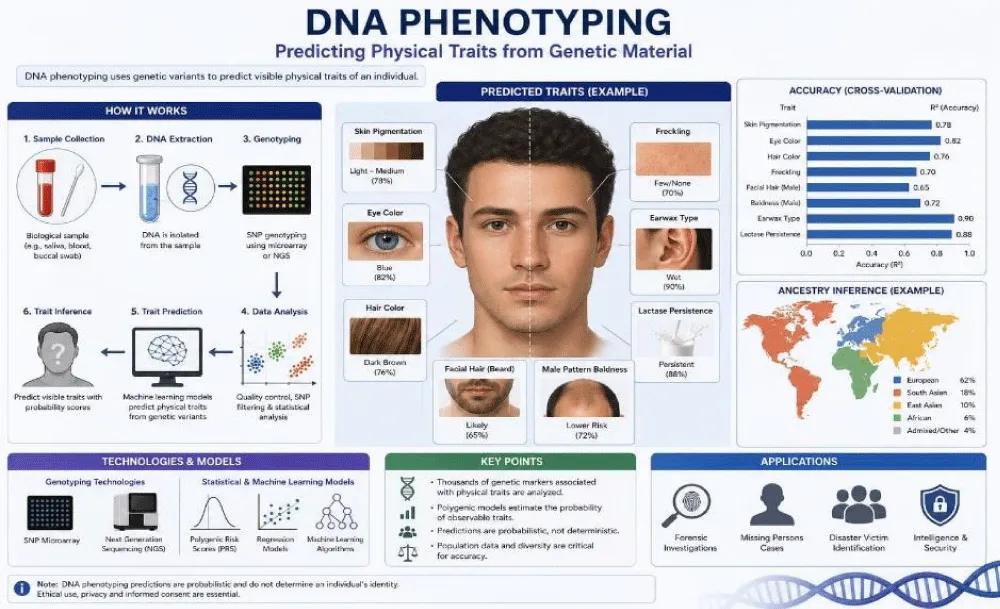
Figure 1:
Predicting face shape
Face morphology prediction is predicting facial traits from genetic information. One of the more difficult components of DNA phenotyping is the shape of the face, which is affected by several genes and environmental conditions. Based on genetic differences that affect craniofacial development, scientists can predict facial traits in terms of nose shape, jaw structure and the extent to which cheekbones protrude, as well as the symmetry of the face. Advanced computer models and machine learning technologies are increasingly used for the reconstruction of approximation face features from DNA. But even so, the accuracy is limited, and the forecasts are more like broad, not precise, representations. This makes the technique more appropriate for examining clues than for ultimate identification.
Biogeographical origins and ancestry
DNA phenotyping can also reveal an individual’s ancestry and biogeographical origins by analysing genetic markers that differ between groups. These markers are generally ancestry informative markers (AIMs) that can be used to identify potential geographic regions or populations of a person’s ancestors. Genetic distinctions can indicate if someone is of African, European, East Asian or South Asian origin. This information can be highly beneficial in decreasing the number of suspects in a forensic investigation. However, the interpretation of ancestry data can be challenging and needs to be handled with caution as populations are progressively intermixing.
Techniques and technologies
DNA phenotyping combines sophisticated molecular and computational methods to forecast outwardly visible characteristics (EVCs) from genetic information. The principal methods used in this field include
Polymerase Chain Reaction (PCR) based methods
The basic technique, PCR, is used to amplify target sections of DNA from minute or damaged samples.
The reason is this: It utilises many genetic markers, including Single Nucleotide Polymorphisms (SNPs) that are associated with characteristics such as hair or eye colour. It allows for the amplification of millions of copies of DNA from small amounts of biological material such as blood or saliva. This is very sensitive and is suitable for forensic materials. Forensic materials are often degraded.
Crime Scene Biological Sample
↓
DNA Extraction
↓
DNA Quantification
↓
SNP Genotyping / NGS
↓
Bioinformatics Analysis
↓
Prediction Models
(IrisPlex / HIrisPlex-S / AI)
↓
Predicted Traits
• Eye colour
• Hair colour
• Skin colour
• Freckles
• Age estimation
↓
Investigative Lead
Forensic significance
It can also be used to analyse DNA samples that include very small amounts of material, and this is an important technique for the phenotyping of crime scene materials.
SNP genotyping assay
The genome contains single-base alterations that are linked to phenotypic features, and they can be identified via SNP genotyping. It uses SNP panels already known to affect characteristics such as ancestry and skin colour. Common tests are multiplex assays that test many SNPs at one time. An example of a prediction model is HIrisPlex.
Forensic significance: Offers a genetic basis for the prediction of features like skin colour, eye colour and hair colour (Figure 2).
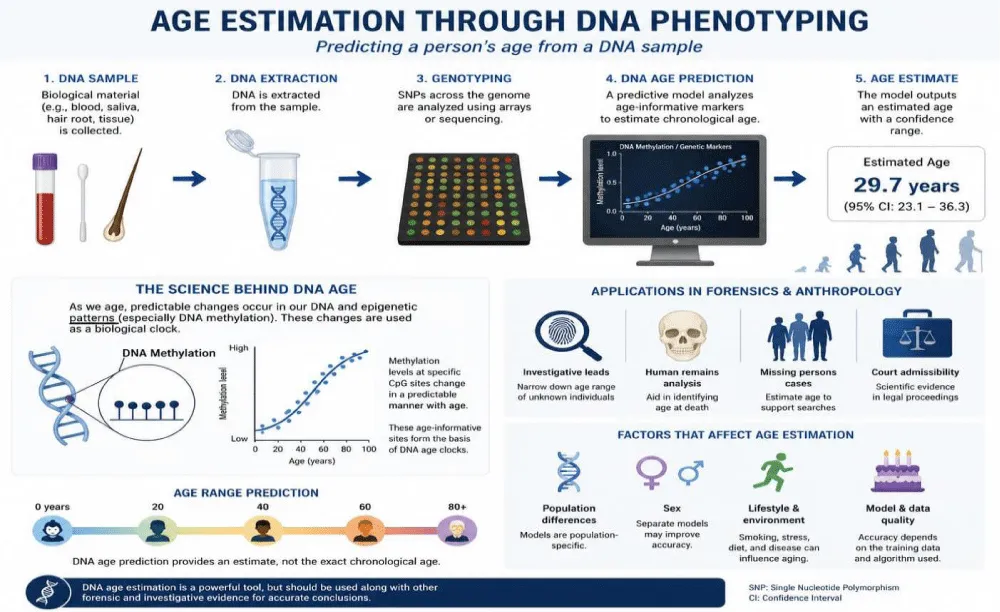
Figure 2:
Next Generation Sequencing (NGS)
NGS is a high-throughput sequencing technique that enables the examination of thousands of DNA fragments in parallel.
- It may sequence hundreds of SNPs and genes in one run.
- It contains a lot of genetic information, including unusual variants.
- Better and more thorough than the usual ways.
- NGS can also evaluate very degraded or mixed DNA, which is important in forensics. Forensic results are also more precise.
Epigenetic methods (study of DNA methylation)
The approach examines chemical changes to DNA to estimate a person's age and sometimes what tissue type they have (without affecting the sequence). It focuses on methylation patterns at single CpG sites. The patterns unfold systematically during the life period. Bisulfite sequencing or methylation-specific PCR can be used for analysis. Forensic science is also valuable in phenotyping because it may help determine the biological age of an individual using DNA evidence.
Microarray-technologie
- Microarrays give us a window into thousands of genetic markers at once.
- The DNA fragments adhere to probes linked to the chip.
- Widely used in various analyses of SNPs.
- Fast handling of a huge number of samples compared to conventional methods. Relevance to forensic science: Not as widely used in modern forensic work as NGS, but it is useful in population research and ancestry prediction.
- Massively parallel sequencing (MPS): A type of NGS that is tailored for forensic applications.
- Allows multiplex sequencing of numerous samples for multiple genetic markers.
- High-resolution data for predicting phenotype.
Table 1. Comparative Evidence Of DNA Phenotyping Systems for Predicting Externally Visible Characteristics
| Table 1: Comparative Evidence of DNA Phenotyping Systems for Predicting Externally Visible Characteristics (EVCs) | |||||||
| Predicted Trait | Principal Genetic Markers / Panel | Typical Sample Requirement | Validated Population(s) | Performance Metrics | Major Limitations | Forensic Readiness | Representative References |
| Eye Colour | IrisPlex (HERC2, OCA2, SLC24A4, SLC45A2, TYR, IRF4) | ≥50 pg genomic DNA; degraded samples generally acceptable | European, South Asian, East Asian, admixed populations | AUC: 0.90–0.98; Sensitivity (Blue/Brown): 85–95%; Specificity: 88–97% | Lower accuracy for intermediate eye colours; ancestry influences prediction | High | Walsh et al., 2011; Chaitanya et al., 2014; Zheng et al., 2021 |
| Hair Colour | HIrisPlex-S (MC1R, HERC2, OCA2, TYR, IRF4, SLC45A2, KITLG) | ≥100 pg DNA | European and multi-ethnic datasets | AUC: 0.82–0.95; Black/Brown prediction >85%; Red hair >90% | Hair dyeing, ageing and environmental exposure do not reflect genotype | High | Walsh et al., 2013; Ruiz et al., 2017; Frieden et al., 2022 |
| Skin Pigmentation | HIrisPlex-S (SLC24A5, SLC45A2, TYR, TYRP1, HERC2, OCA2, MC1R) | ≥100 pg DNA | Worldwide populations | Overall accuracy: 75–90%; AUC: 0.80–0.93 | Reduced accuracy in highly admixed populations; continuous variation | Moderate–High | Chaitanya et al., 2014; Liu et al., 2019; Zheng et al., 2021 |
| Freckles | MC1R variants, IRF4 | Moderate-quality DNA | Primarily European ancestry | Accuracy: ~70–80% | Strong environmental influence (UV exposure); limited validation | Experimental | Walsh et al., 2013; Frieden et al., 2022 |
| Male Pattern Baldness | AR/EDA2R and polygenic SNP panels | High-quality DNA | Mainly European populations | Moderate predictive performance (AUC ≈0.70–0.80) | Age-dependent and hormone-dependent trait | Experimental | Visser et al., 2016; Friedman et al., 2019 |
| Facial Morphology | Polygenic SNP panels (PAX3, DCHS2, EDAR, RUNX2, GLI3, PRDM16, etc.) | High-quality DNA with dense genotyping | Limited research cohorts | Low–Moderate prediction accuracy | Highly polygenic; strong environmental and developmental effects | Research Stage | Claes et al., 2014; Manrai et al., 2016; Zheng et al., 2022 |
| Age Estimation | DNA methylation markers (ELOVL2, FHL2, KLF14, PDE4C, ASPA) | High-quality bisulfite-treated DNA | Multiple populations (multi-ethnic) | Mean Absolute Error (MAE): ~2–5 years | Tissue-specific methylation; disease and lifestyle effects | Moderate | Vidaki & Kayser, 2015; Jung et al., 2017; Hayou et al., 2021 |
| Biogeographical Ancestry | Ancestry Informative Markers (AIMs); Precision ID Ancestry Panel | ≥100 pg DNA | Global reference populations | Accuracy frequently >90% for continental ancestry | Does not directly predict physical appearance; admixture complicates interpretation | High | Phillips et al., 2014; Patterson et al., 2020; Haak et al., 2021 |
| Footnote: Performance values are approximate ranges reported across multiple validation studies and may vary depending on the prediction model, population, marker panel, and validation dataset. Abbreviations: AUC = Area Under the Receiver Operating Characteristic Curve; MAE = Mean Absolute Error; SNP = Single Nucleotide Polymorphism; EVC = Externally Visible Characteristic; pg = picogram |
|||||||
Recent advances in next-generation sequencing
Recent developments in next-generation sequencing (NGS) have significantly enhanced forensic DNA phenotyping by enabling simultaneous analysis of thousands of genetic variants in a single experiment. Unlike conventional capillary electrophoresis-based STR typing, NGS provides sequence-level information, allowing investigators to examine SNPs, insertions, deletions, and mitochondrial DNA within the same workflow. This comprehensive genetic information improves phenotype prediction while reducing sample consumption, making NGS particularly valuable for degraded forensic specimens. Although the technology remains relatively expensive and requires specialised bioinformatics expertise, ongoing improvements are expected to facilitate broader implementation in forensic laboratories.
Machine Learning in DNA Phenotyping
Machine learning algorithms have emerged as valuable tools for improving phenotype prediction from genomic datasets. Traditional statistical models often assume linear relationships between genetic variants and observable traits, whereas machine learning approaches can identify complex interactions among multiple loci. Random Forests, Support Vector Machines, Gradient Boosting, and Artificial Neural Networks have demonstrated improved prediction accuracy for characteristics such as pigmentation and age estimation. However, the reliability of these models depends heavily on the availability of diverse, well-annotated training datasets to minimise bias and enhance generalizability.
Artificial intelligence in forensic genomics
Artificial intelligence is increasingly being integrated into forensic genomics to assist with data interpretation, phenotype prediction, and automated quality assessment. AI systems can process large genomic datasets more efficiently than conventional analytical approaches and may support investigators by identifying subtle genetic patterns that would otherwise remain undetected. Nevertheless, AI should be regarded as a decision-support tool rather than a replacement for forensic experts. Transparency, explainability, validation, and ethical oversight remain essential before AI-based predictions can be routinely accepted in judicial proceedings.
Performance evaluation of DNA phenotyping models
The performance of forensic DNA phenotyping systems should be evaluated using standardised statistical measures rather than overall prediction accuracy alone. Sensitivity and specificity quantify the ability of a model to correctly identify positive and negative cases, respectively, while the area under the receiver operating characteristic curve (AUC) reflects the model's overall discriminatory performance. Calibration analysis assesses the agreement between predicted probabilities and observed outcomes. For quantitative traits such as age estimation, Mean Absolute Error (MAE) provides a useful measure of prediction accuracy. Confidence intervals should accompany reported performance metrics to indicate statistical uncertainty and facilitate comparison across validation studies.
Forensic significance
- Improves the capacity and expertise of forensic laboratories.
- Statistical Modelling & Bioinformatics
- Computational approaches are very useful for analysing genetic data, and for turning genetic data into predictions of phenotypes. Reason:
- Uses databases and algorithms to find correlations between SNPs and phenotypes.
- The predictions of the machine learning models are better.
- The tools give you results based on luck (80% chance of blue eyes). Relevance to forensics
- Turns basic genetic information into meaningful research leads.
- Artificial Intelligence (AI) and Machine learning: AI is being used to investigate complex genetic links and improve predictions. Reason: “
- Finding patterns in big genomic data sets.
- The ability to predict complex things like the contour of the face.
- Uses new knowledge to learn and make better guesses.
- The future of DNA phenotyping is in its utility to forensic research, enabling more detailed and specific reconstructions.
- Technologies for Forensic DNA Phenotyping
- Forensic phenotyping is carried out using technologies and kits that are commercially accessible for this purpose. Reason:
- Software for SNP prediction and analysis.
- Deliver Accurate and validated results for every user.
- They include technologies that can forecast a person’s skin colour, hair and eye colour. Relevance of forensics.
- It provides dependability and reproducibility in forensic laboratories.
Applications to forensic science
DNA phenotyping predicts physical and biological qualities based on genetic data and is therefore a helpful tool in forensic investigations. Identification by comparison is classic DNA profiling, but DNA phenotyping can provide you with leads when you have no suspect.
1. Search for unknown suspects
DNA phenotyping is the process in which we obtain DNA, and we offer you all the biological information you need to construct a profile of an unknown individual from evidence taken from a crime scene.
This data can be used to predict skin colour, hair colour, eye color other ancestral traits.
That means cops can narrow down the field of suspects.
I’m going to look at the data.
“If they don’t have a suspect in any DNA banks, phenotyping gives them more information about what that suspect could look like.”
2. Cold Case Investigations
DNA phenotyping might be helpful if normal evaluation approaches have little progress. New procedures have been created to sample DNA so that you can re-analyse any preserved DNA sample that might suddenly be important to make a case more successful. They can give law.
Enforcement organisations lead and provide evidence even decades after a case goes cold. It breathes new life into cold cases and helps boost the rate of cases solved.
3. Identification of Missing Persons
Identification of missing persons. This is the situation when only biological samples are available for their identification. They can be used by detectives or in public appeals to predict the physical traits of a missing person. They are commonly used in conjunction with established identification procedures, such as dental records.
4. Disaster Victim Identification (DVI)
DVI supports the identification of victims of major incidents such as terrorist attacks, natural disasters and plane crashes. They can provide information about a victim’s appearance and ancestry to help identify a victim when it is difficult to directly identify a person (i.e., the body is fragmented/decimated/unidentifiable).
5. Human Remains Identification
They are utilised to help recreate physical features to identify skeletal remains in forensic anthropology for more accurate identification of the remains. It helps to identify old and/or damaged remains.
6. Intelligence-Led Policing
It is investigative intelligence, not hard evidence. Allows law enforcement agencies to deploy resources to specified demographic groups or geographic locations. It is used to synthesise anomalous sketches from anticipated attributes.
7. Biogeographical Ancestry and Origin Analysis
- Determines the most likely location of a person's ethnicity.
- Helps detectives figure out the ethnicity of a suspect or victim.
- It is useful in international or trans-border crimes.
8. Identification by Age
- Predicts biological age using epigenetic indicators (i.e. DNA methylation patterns).
- Filter suspects by approximate age range
- Will provide essential material where there is no eyewitness remark.
9. Help With Facial Reconstruction
DNA phenotyping can be used to find out the form and structure of one’s face. There are various approaches to digital facial reconstruction. It’s early days, but the indicators are positive.
10. Innocence Verification and Exonerations
Helps to screen out likely suspects with no expected phenotype, helps to avoid potential false charges and promotes unbiased investigations.
11. Forensic Applications & Non-Human Wildlife
The same methodologies utilised in non-human forensic science applications could be used to determine species by inferring particular features and to investigate crimes against wildlife. It also helps in the fight against illegal trafficking and poaching.
Benefits of DNA phenotyping
- Good if no suspect
- With traditional DNA profiling, you need a sample to compare against.
- But DNA phenotyping can nevertheless produce a predicted profile where there is no proven suspect.
- This allows investigators to begin an inquiry with very little data.
- investigation of leads creation
- Provide indications about physical features such as skin colour, hair colour, and eye colour.
- Helps law enforcement identify potential suspects
- Provides the generation of descriptions of suspected persons in the absence of witnesses.
Suitable for limited/degraded samples
- Use of small amounts of DNA (hair, saliva, touch DNA, etc.).
- “Modern technology can work with even compromised DNA. It works great for aged situations or harsh climate scenarios.
- Allows for the re-examination of previously obtained biological samples using current methodologies.
- It reveals new clues in cases that have remained unresolved for a long time.
- Increases the chances of habitual criminals being detected.
- Helps find lost people
- Foreshadows physical features of unknown people.
- Provides assistance in appearance correction for public release.
- Complements other identification processes, such as anthropological and dental research.
Disaster Victims Identification (DVI) Assistance is useful in circumstances where the remains are fragmented, highly damaged or decomposing. It is beneficial in evaluating features that are not easily perceived immediately. Improves identification efforts following mass tragedies. Gives ancestry and biogeographical information. Estimation of a person’s likely ethnicity or geographic ancestry. It’s handy for academics who are targeting certain demographic categories.
- You Can Guess The Age
- Evaluates epigenetic modifications (DNA methylation signatures) to estimate biological age.
- Helps to filter down suspects by age group.
- Adds another layer of detail to the forensic profile.
- Cuts investigative time and cost
- It cuts down the number of suspects, and so saves needless investigation.
- Helps to allocate resources to law enforcement more intelligently.
- Increases the overall effectiveness of criminal investigations.
Disadvantages and challenges
While DNA phenotyping shows promise, several important limitations and challenges restrict its acceptance and utility in forensic practice. One key issue is that the predictions are probabilistic rather than deterministic; therefore, the results give a probability of particular qualities rather than explicit descriptions, which may be misinterpreted by investigators. Prediction accuracy is particularly limited, as complex aspects such as body type, face morphology and behavioural traits are influenced by multiple genes and environmental factors. Environmental factors such as lifestyle, nutrition and light exposure can also change physical traits, reducing the accuracy of genetic forecasts. Population bias is another problem. Many of the prediction models are based on data sets that represent specific populations but may not be as accurate for different ethnic groups. Quality and quantity of DNA samples are equally critical. For example, tainted or damaged samples could distort results. There are also major ethical and legal concerns, including the ability to reinforce racial profiling or bias, privacy difficulties, and the abuse of genetic data. The lack of clear universal norms and the disparities among the legal systems of different countries additionally complicate the application in forensic investigations.
Eethical, legal and social implications
Ethical, Legal and Social Implications (ELSI) of DNA phenotyping in forensic research are complex and controversial. One of the key ethical challenges is privacy, since genetic information may reveal more than the simple identity of a person. DNA profiling is about identity; phenotyping is about the prediction of physical characteristics. This raises questions of genetic surveillance and the exploitation of personal data. There is a high potential for reinforcing racial or ethnic stereotypes in society, especially when ancestry or appearance projections are utilised in criminal investigations, which could lead to biased enforcement or prejudice against certain communities. DNA phenotyping evidence is probabilistic, not conclusive, and hence courts sometimes question the reliability of DNA phenotyping evidence. Where you are has so much to do with the admissibility of DNA phenotyping evidence. There are also fears that the lack of specific legislation on the sharing, usage and storage of genetic data could be exploited by other parties or law enforcement agencies. The ongoing difficulty of balancing public safety and individual rights highlights the requirement of developing robust ethical standards, clear norms and solid legal structures to enable the responsible use of DNA phenotyping while respecting fundamental human rights. Although forensic DNA phenotyping provides valuable investigative intelligence, its application raises important ethical, legal, and societal concerns. Predictions regarding externally visible characteristics may reveal sensitive personal information, emphasising the importance of privacy protection and responsible data governance. The use of DNA collected from individuals should comply with applicable legal frameworks and informed consent requirements whenever appropriate. Furthermore, predictive models trained predominantly on specific ancestral groups may exhibit reduced performance in underrepresented populations, potentially introducing systematic bias into forensic investigations. Differences in national regulations also influence the permissible scope of forensic DNA phenotyping, with some jurisdictions restricting its application to pigmentation traits while others permit broader investigative use. Consequently, standardised international guidelines, rigorous scientific validation, and transparent reporting practices are essential for ensuring ethical implementation.
Future prospects
The future of DNA phenotyping is quite promising, due to the rapid development of genomics, computational biology and forensic technology. New advancements are predicted to greatly increase the accuracy, extent and reliability of predicting physical characteristics from genetic material. One of the most essential pathways is the integration of state-of-the-art sequencing technologies, especially whole-genome sequencing and Next-Generation Sequencing (NGS). These approaches enable the incorporation of many more genetic markers, especially dense SNP panels, that can improve prediction accuracy for complex traits such as skin pigmentation and face morphology. Another key development is the use of artificial intelligence (AI) and machine learning. These approaches can be used to explore massive genomic data sets to detect complex relationships between genetic variation and phenotypic features. AI should make models more predictive and less susceptible to human bias in interpretation. Multi-omics methods such as transcriptomics, genomics, epigenomics and microbiome studies can take DNA phenotyping even farther. For example, gene expression data might be utilised for identifying lifestyle or environmental effects, and DNA methylation markers are increasingly employed for the correct prediction of age.
Future studies will also examine facial reconstruction from DNA, using genetic information to produce very accurate 3D scans of faces. This technology might revolutionise the way that we identify suspects when there is no database match or eyewitness, but is still in the early phases of study. Automation and high-throughput analytical pipelines will also allow for faster, cheaper and more scalable DNA phenotyping for routine forensic usage. Integration with genetic genealogy technologies and forensic DNA databases may boost its potential to solve cold cases and identify unknown persons further. But the future of DNA phenotyping also means that we need to address ethical, legal and cultural challenges such as privacy concerns, potential misuse of data and potential for racial profiling. The need for worldwide regulations and regulatory frameworks is crucial for the proper use of this technology and equitable use.
DNA phenotyping is a huge achievement in forensic research since it goes beyond basic DNA profiling and may predict externally apparent features and biogeographical ancestry from genetic information. It can be a valuable investigative tool, particularly in circumstances where traditional identification methods are not acceptable, such as deteriorated materials, missing persons and cold cases. Technologies have emerged that can predict features such as eye colour, hair colour, skin pigmentation and age. These include SNP analysis, next-generation sequencing and epigenetic markers. These breakthroughs have enhanced the capacity of forensic biology to provide investigative leads and minimise the number of potential suspects. There are some drawbacks to DNA phenotyping. This also highlights the necessity of cautious interpretation considering the probabilistic nature of forecasts, the impact of the environment on features and the challenges of precisely reconstructing complex aspects such as facial shape. Furthermore, relevant legislation and standards should carefully consider the ethical, legal and societal issues such as privacy difficulties and potential for misuse. In conclusion, DNA phenotyping is a powerful supplemental tool in forensic investigations but not a substitute for direct identification methods. With more research, technological breakthroughs and correct application, it has significant potential for the future of forensic science and human identification."
- Kayser M. Forensic DNA phenotyping: Predicting human appearance from crime scene material for investigative purposes. Forensic Sci Int Genet. 2015;18:33‑48. Available from: https://dx.doi.org/10.1016/j.fsigen.2015.02.003
- Kayser M, de Knijff P. Improving human forensics through advances in genetics, genomics and molecular biology. Nat Rev Genet. 2011;12(3):179‑192. Available from: https://doi.org/10.1038/nrg2952
- Walsh S, Liu F, Ballantyne KN, van Oven M, Lao O, Kayser M. IrisPlex system for eye and hair colour prediction. Forensic Sci Int Genet. 2013;7(1):98‑115. Available from: https://doi.org/10.1016/j.fsigen.2012.07.005
- Kayser M, Schneider PM. DNA‑based prediction of human externally visible characteristics for forensic purposes. Forensic Sci Int Genet. 2009;3(3):154‑161. Available from: https://doi.org/10.1016/j.fsigen.2009.01.012
- Chaitanya L, Breslin K, Zuñiga S, Wirken L, Pośpiech E, Kukla-Bartoszek M, et al. HIrisPlex‑S system for eye, hair and skin colour prediction from DNA. Forensic Sci Int Genet. 2018;35:123‑135. Available from: https://doi.org/10.1016/j.fsigen.2018.04.004