
More Information
Submitted: September 24, 2026 | Accepted: October 01, 2026 | Published: October 02, 2026
Citation: Lakra G. Forensic Analysis of Bloodstain Pattern on Rough Surfaces: Interaction and Limitations. J Forensic Sci Res. 2026; 10(2): 151-153. Available from:
https://dx.doi.org/10.29328/journal.jfsr.1001124
DOI: 10.29328/journal.jfsr.1001124
Copyright license: © 2026 Lakra G. This is an open access article distributed under the Creative Commons Attribution License, which permits unrestricted use, distribution, and reproduction in any medium, provided the original work is properly cited.
Keywords: Bloodstain pattern analysis; Rough surface; Surface topography; Environmental factors; Crime scene reconstruction

Forensic Analysis of Bloodstain Pattern on Rough Surfaces: Interaction and Limitations
Godson Lakra*
Research Scholar, Department of Forensic Science, Kalinga University, Raipur, Chhattisgarh
*Corresponding author: Godson Lakra, Research Scholar, Department of Forensic Science, Kalinga University, Raipur, Chhattisgarh, India, Email: [email protected]
Blood pattern analysis is a discipline that uses the field of biology, physics and mathematics widely used in forensic science to reconstruct the activities involving bloodstain. Most of the studies are derived from experiments on rough and porous surfaces, limiting their applicability to real cases dominated by rough and irregular surfaces. This analysis critically examines the behaviour of blood droplets on rough surfaces (Cemented floor, cemented wet floor and cloth) chosen a particular season i.e., Rainy with the same angle and same height of 5.5 feet on different objects of rough and porous surface, For the analysis of blood Stain pattern the real human blood stain is taken from hospital and volunteer- only after the approval of hospital authorities and volunteer consent. The study and analysis is focusing on Passive blood stain deposition and the effect of surface topography (Porous surface) and environmental variables. The analysis identifies key research gaps and proposes a multi parameter texture for advancing blood pattern analysis on complex surface.
Blood stain patterns are created when a blood source receives a blow for force resulting from random Dispersion of a small drop of blood depending on spreading behaviour, surface texture and velocity. The position size and the shape of the blood stain often help in the reconstruction of the scene of crime the blood stain may be in the form of splashes, smear and pools, it should be carefully noted and photograph taken whenever possible. A drop of blood, striking the surface at right angle from a lesser height will give rise to a symmetrical round shape pattern with further increase in height secondary factors completely encircle the primary spots are formed. The greater the velocity of the falling drops the greater will be the spread of secondary spatters. If the drop strike the surface at an angle other than 90 degree the better will be a symmetrical and the spot will assume a pear shape, the effect will be height by great velocity of the drop and by smaller angle of incident. Blood Pattern Analysis BPA is a discipline that uses the field of Biology (behaviour of blood), Physics (cohesion, capillary action and velocity) and Mathematics (geometry, distance and angles). Types of blood stain; Passive Blood stain - blood stain pattern formed due to the influence of gravity no extra force is applied. passive bloodstain is separated into 4 categories; Transfer stain occurs when two surfaces come into contact and one surface is wet with blood, Drops stain occurs when blood falling straight down (circular shape) due to surface tension until they reach their destination, Pooling stain occurs when the source of bleeding remains static for a certain period of time, blood continuously dripping in the same location resulting in blood collecting at one place, Drip pattern occurs due to repeated drops on the surface from the same source; Impact Stain pattern - It is the most common bloodstain pattern type found in the crime scene. This blood stain pattern occurs when an object hits a source of blood, blood is often circular and not elongated. There are two types of impact Stain pattern i.e., Back spatter and forward spatter. Back spatter occurs when blood is projected back to the attacker whereas forward spatter occurs when blood exists directly from the victim's wound and projects nearby surfaces. In this analysis it seemed.
Blood droplets dropped from the height of 5.5 feet into the rough surface focusing on the pattern, texture and environment variable created on the surface. For the analysis of the blood stain pattern we worked with a real human blood sample for the accuracy in crime scene investigation.
Objective
To analyse blood stain pattern variation and the effect of impact, drop height and volume across different surface type (Rough Surface, Cemented floor, wet cemented floor and cloth).
Fresh or simulated blood is taken from the hospital after the approval of hospital authorities and volunteer consent. A medical syringe used as a dropper to control the blood volume and measuring tape to measure the height. Rough surface (Cemented floor, wet cemented floor and cloth) is chosen for dropping the blood from the same height on different rough surface types. The experiment is conducted in both indoor and outdoor scenes for environmental variation such as temperature and humidity. Followed by allowing the blood droplets to fall freely onto the surfaces and repeating the process for consistency from the same height.
Observation
A total of three surface types were examined, with two drops of blood released from a height of 5.5 ft onto dry, wet and fabric surface conditions. The temperature was 30°C during dry cemented and the fabric surface, and 28°C during rainfall, humidity around 78% to 80% during all experiments. The stain morphology recorded on the dry, rough cemented surface is presented (Figure 1).
Two drops of blood released from a height of 5.5 ft onto 3 surface types. Figure 1. a dry rough surface exhibited an irregular bloodshed and fragmented stain with uneven margins and small satellite like droplets. The observed morphology indicates an interaction between the blood droplets and the micro topography of the rough surface with a diameter of approximately 3 cm to 3.7 cm. Figure 2. A wet, rough cemented surface blood released during rainfall produced an irregular and diffuse stain with a concentrated central area showing increased spreading due to rainfall. The observed morphology indicates the combined influence surface of roughness and moisture on the interaction and subsequent distribution of droplets with a diameter of approximately 3.4 cm to 4.7 cm. Figure 3. A dry fabric surface produced an irregular diffuse stain due to high absorbance capacity on fabric surface resulting a less defined margins and a morphology influenced by the porous and textured of the cloth with a diameter of approximately 3.4 cm to 4.7 cm. The study shows that factors such as surface roughness, porosity, absorbency, and moisture can affect the final appearance of bloodstains. These observations suggest that the surface on which a bloodstain is found should be considered carefully during forensic examination. However, further repeated experiments and quantitative measurements are needed to confirm these observations and establish more reliable relationships between surface type and bloodstain characteristics.
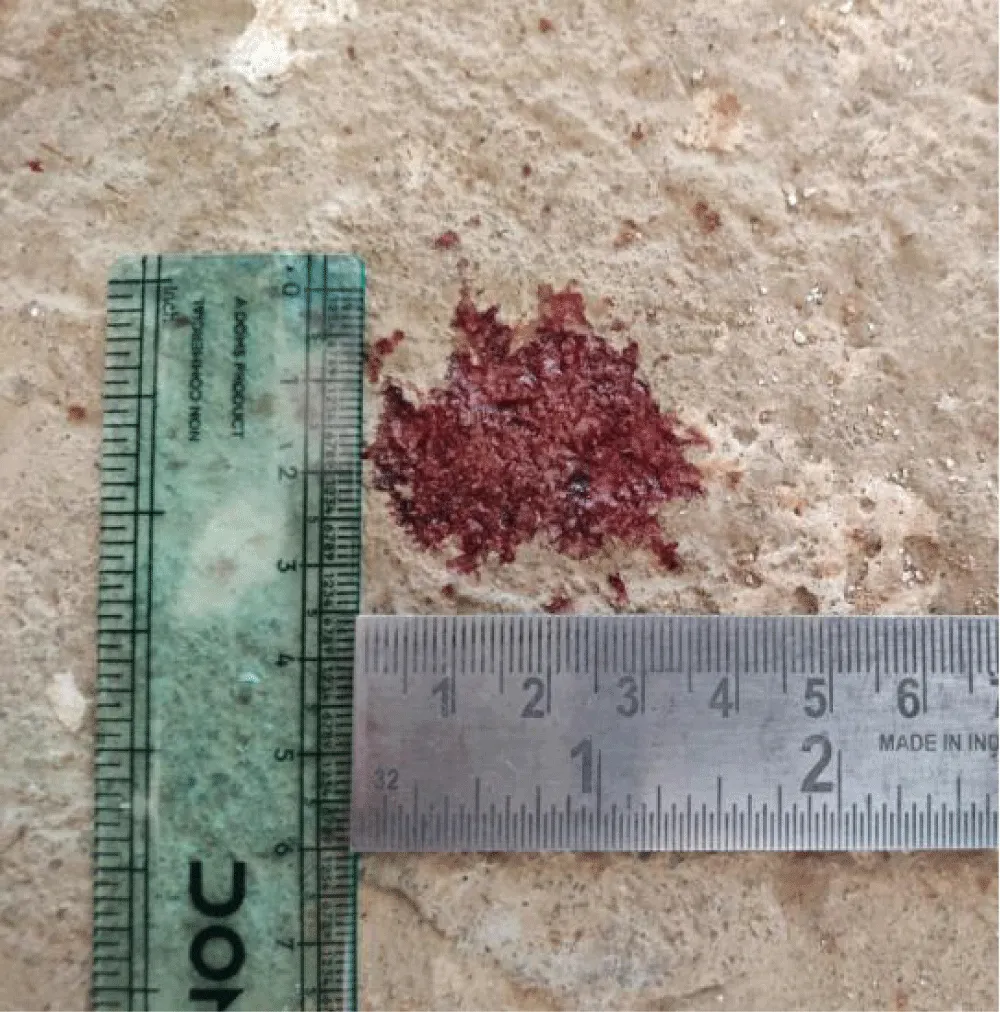
Figure 1: Blood stain morphology produced by two drops of blood released from a height of 5.5 ft onto a dry rough (cemented) surface, photographed with metric and imperial scales for reference.
| Observation Table 1 | |
| Parameter | Observation |
| Number of drops | 2 drops |
| Surface | Dry, rough / porous surface |
| Drop height | 5.5 ft |
| Surface condition | Dry surface |
| Stain appearance | Irregular, fragmented blood stain |
| Shape | Roughly circular |
| Edge | Small projections |
| Colour | Dark reddish brown |
| Diameter | The observed blood stain diameter/linear dimension ranged approximately from 3 cm to 3.7 cm. |
| Distribution | Concentrated in the central area with small peripheral droplets |
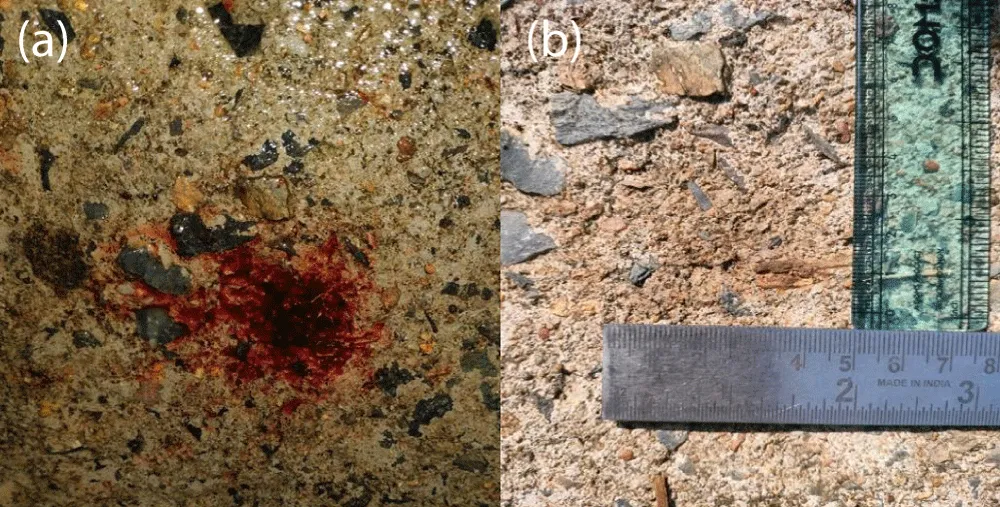
Figure 2: (a). Bloodstain morphology produced by two drops of blood released from a height of 5.5 ft onto a wet cemented surface during rainfall. (b). Same wet cemented surface area photographed with a metric and imperial scale for dimensional reference.
| Observation Table 2 | |
| Parameter | Observation |
| Number of drops | 2 drops |
| Surface | Cemented surface, wet during rainfall |
| Drop height | 5.5 ft |
| Surface condition | Wet due to rainfall |
| Stain appearance | Irregular and diffuse appearance |
| Shape | Irregular with poorly defined margins |
| Edge | Irregular edges due to surface texture and moisture |
| Colour | Dark red to reddish brown |
| Diameter | The observed blood stain diameter/linear dimension ranged approximately from 3.4 to 4.7 cm |
| Peripheral features | Fine extensions / small irregular deposits visible around the central area |
| Distribution | Concentrated central deposition with irregular outward spread |
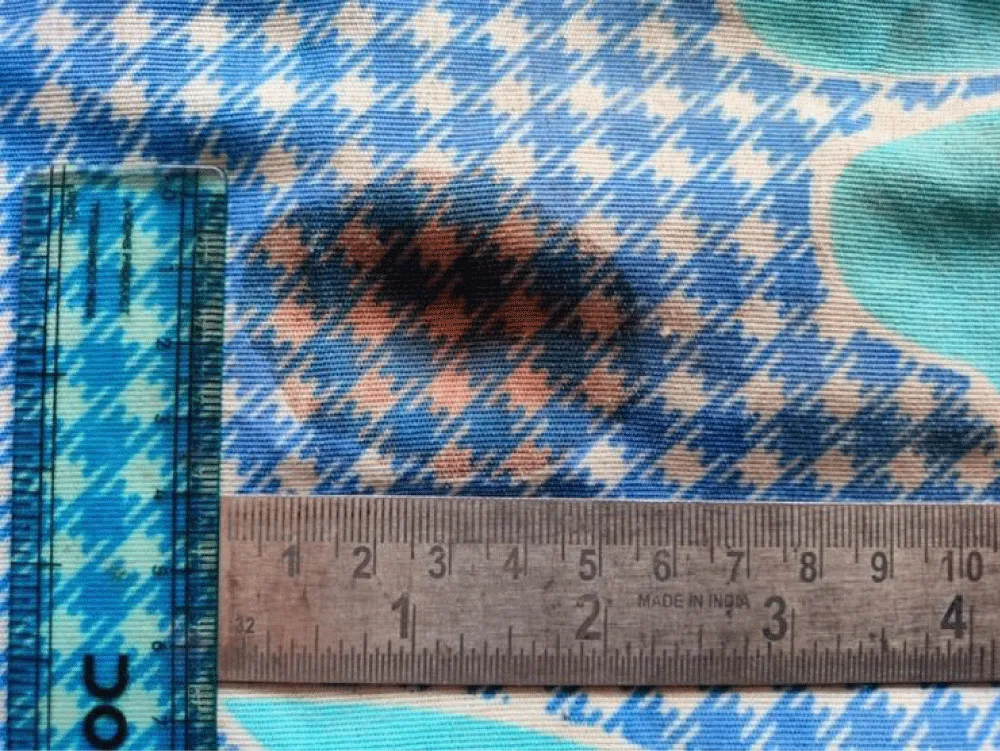
Figure 3: Bloodstain morphology produced by two drops released from a height of 5.5 ft onto a dry cloth surface.
| Observation Table 3 | |
| Parameter | Observation |
| Number of drops | 2 drops |
| Surface | Cloth/fabric |
| Surface condition | Dry |
| Surface type | Porous/absorbent |
| Drop height | 5.5 ft |
| Stain appearance | Irregular and elongated diffuse |
| Shape | Irregular, following the fabric texture |
| Margins | Not sharply defined |
| Colour | Dark reddish brown |
| Diameter | The observed blood stain diameter/linear dimension ranged approximately from 3.4 to 4.7cm. |
| Peripheral features | Small irregular extensions are visible |
| Distribution | Localised stain with spreading along the fabric surface |
Limitation
The present study was conducted as a preliminary observation using a fixed drop height of 5.5 ft and a limited number of blood drops for each surface condition. The study did not include multiple drop heights. Therefore, the findings should be interpreted as preliminary observation rather than generalized quantitative conclusion. Future studies should incorporate larger sample size, multiple drop heights, controlled drop volume, and systematic recording of environmental parameters. The rough cemented surface has natural variation, particle size and unevenness, which may influence stain morphology. During rainfall, the amount and distribution of water on the cement surface may change over time.
Delimitation
The study includes a comparison between wet and dry conditions, with rainfall considered as the wet environmental condition. The studies focuses on passive blood drop deposition and the resulting stain morphology, rather than impact, cast off, or projected bloodstain mechanism. The study primarily examines shape, size, margins, spreading, fragmentation and satellite stain characteristics. The experiment conducted under predetermined conditions to allow comparison between surface types.
The present preliminary investigation demonstrates that bloodstain morphology may vary according to the characteristics and condition of the receiving surface. Dry rough cemented surfaces produced irregular and fragmented stains with peripheral projections, whereas wet cemented surfaces showed more diffuse spreading and poorly defined margins. The dry fabric surface produced diffuse and elongated staining influenced by the porous and textured nature of the material. These observations indicate that surface roughness, porosity, absorbency, and moisture may influence the final appearance and distribution of passive bloodstains.
However, the findings should be interpreted cautiously because the investigation was conducted using a fixed drop height of 5.5 ft and only two drops per surface condition. The absence of multiple drop heights, larger numbers of experimental replicates, and detailed quantitative repeatability analysis limits the generalizability of the findings. Further controlled experiments involving multiple drop heights, standardized blood volume, increased replication, and systematic environmental measurements are required to establish more reliable relationships between surface characteristics and bloodstain morphology.
- Fang T. Physical characteristics of spatter stain on textile: Influence of impact surface texture, blood drop volume and blood drop velocity. Natl Inst Justice. 2022 May;26.
- Michielsen S, Taylor M, Parekh N, Ji F. Bloodstain patterns on textile surfaces: A fundamental analysis. Natl Inst Justice. 2025 Mar;110.
- Taylor MC, Laber TL, Kish PE, Owens G, Osborne NKP. The reliability of pattern classification in bloodstain pattern analysis, part 1: Bloodstain patterns on rigid non-absorbent surfaces. J Forensic Sci. 2016 Apr;61(4):922-7.
- Neitzel GP, Smith M. Develop insight into blood droplets behaviour for bloodstain pattern analysis. Natl Inst Justice. 2018 Jun;30.
- Joseph MM, Jomon S, Bastian BT. Analysis of passive bloodstain morphology across surface textures and drop height using deep learning. Forensic Sci Int. 2026 Jun;383:112890.
- United Kingdom Forensic Science Regulator. Bloodstain pattern analysis—codes of practice and conduct. London (UK): Forensic Science Regulator; 2025 Jul.