
More Information
Submitted: September 23, 2026 | Accepted: September 25, 2026 | Published: September 28, 2026
Citation: Alketbi SK. Beyond Chain of Custody: A Biological Provenance Record for Activity-Level Interpretation of Trace DNA. J Forensic Sci Res. 2026; 10(2): 131-140. Available from:
https://dx.doi.org/10.29328/journal.jfsr.1001122
DOI: 10.29328/journal.jfsr.1001122
Copyright license: © 2026 Alketbi SK. This is an open access article distributed under the Creative Commons Attribution License, which permits unrestricted use, distribution, and reproduction in any medium, provided the original work is properly cited.
Keywords: Trace DNA; Biological provenance; Chain of custody; Activity-level propositions; DNA transfer; TPPR; Forensic interpretation

Beyond Chain of Custody: A Biological Provenance Record for Activity-Level Interpretation of Trace DNA
Salem K Alketbi1-3*
1The Biology and DNA Section, General Department of Forensic Science and Criminology, Dubai Police General Headquarters, Dubai, UAE
2International Center for Forensic Sciences, Dubai Police General Headquarters, Dubai, UAE
3School of Law and Policing, University of Lancashire, Preston, UK
*Corresponding author: Salem K Alketbi, Biology and DNA Section, General Department of Forensic Science and Criminology, Dubai Police General Headquarters, Dubai, UAE, Email: [email protected]
A DNA profile may be statistically compelling yet historically ambiguous. Strong contributor attribution does not establish when, how, or during which activity biological material reached an exhibit. Those questions depend on information that may lie outside the profile itself, including prior legitimate use, co-users, cleaning, environmental exposure, subsequent handling, collection sequence, packaging, laboratory processing, sampling location, and recovery method. This Short Communication proposes the Biological Provenance Record (BPR), a concise companion to chain of custody designed to preserve the minimum case information relevant to transfer, persistence, prevalence/background DNA, recovery, contamination, and activity-level proposition formulation. The framework follows the exhibit from pre-event history through the alleged event, post-event handling, collection, packaging and transport, laboratory processing, and interpretation. Material information is recorded according to evidential status—documented, reported, disputed, unknown, or not applicable—so that uncertainty is preserved rather than converted into assumed fact. The BPR is not an evaluative algorithm, does not identify the true transfer route, and does not itself justify a numerical activity-level likelihood ratio. Its purpose is to preserve the biological history needed to formulate realistic competing propositions, assess the relevance of TPPR data, recognize dependence and post-event transfer opportunities, and identify when quantification is not defensible. Prospective evaluation is required to determine usability, inter-user consistency, workflow burden, and whether BPR-assisted documentation improves the completeness and transparency of activity-level reasoning.
A DNA profile can be statistically decisive about contributor identity while remaining historically ambiguous. In casework, the disputed question is often not whose DNA was recovered, but whether the findings are more probable if a particular contact or activity occurred than under a competing account. Source- and sub-source-level associations do not, without a separate evaluative step, establish direct contact, deposition time, or offence-related activity [1-5]. This inferential gap matters increasingly as sensitive trace-DNA workflows recover small biological deposits arising from routine use, prior legitimate contact, indirect transfer, persistence, background DNA, packaging, and post-event handling [1,4].
The practical weakness is often information loss rather than analytical failure. Activity-level interpretation depends on case circumstances that connect proposed activities to the observed findings: ownership and habitual use, legitimate handlers, cleaning, environmental exposure, contact sequence, elapsed time, possible intermediaries, scene access, collection order, packaging, laboratory handling, sampling location, and recovery method [3-5]. Many of these facts are perishable. If they are not recorded when known, later reconstruction may be incomplete precisely when the evidential question moves from attribution to activity. A technically robust DNA result can therefore reach evaluation with an inadequately preserved biological history.
Chain of custody protects a different evidential requirement. It documents the chronological possession, transfer, storage, and handling of an exhibit and supports the proposition that the item examined is the item collected [6-9]. It was not designed to capture every process capable of altering the biological material on that item. Formal continuity can remain intact while uncertainty persists about pre-existing DNA, subsequent use, glove- or tool-mediated transfer, movement within packaging, or whether the sampled location still reflects the original deposition site [6,9-12]. These uncertainties become material only when the DNA finding is used to address an activity rather than identity alone.
This Short Communication proposes a Biological Provenance Record (BPR) to preserve that missing layer of information. The BPR is a structured companion to chain of custody that records the minimum case information relevant to transfer, persistence, prevalence/background DNA, recovery, contamination, and proposition formulation across the pre-event, event, post-event, collection, packaging, transport, and laboratory history of an exhibit. It does not determine which history occurred and is not an evaluative model. Its purpose is to retain information needed for later proposition-based reasoning, consistent with guidance that activity-level value depends on explicit competing propositions, stated conditioning information, and empirically relevant TPPR data [2-5,13].
Evidential continuity versus biological history
Chain of custody and biological provenance preserve different kinds of continuity. Chain of custody addresses exhibit identity and accountability: who collected or possessed the item, when and where it was transferred, how it was stored, and whether documented integrity was maintained [6,8,9]. Biological material is more dynamic. DNA may predate the event of interest, persist from legitimate use, move between regions of an item, transfer to or from packaging, or be introduced during later handling without any break in formal custody [10-12]. An intact possession history therefore does not, by itself, reconstruct the history of the DNA recovered from the exhibit.
The distinction is functional, not administrative. Many organizations already record fragments of biological history in scene notes, evidence-management systems, examination worksheets, contamination records, and case communications. The interpretive problem is fragmentation: information collected for different operational purposes may never be assembled around the propositions eventually disputed. Biological provenance isolates the subset capable of changing the expected DNA findings under competing histories. Chain of custody asks whether the exhibit can be traced through documented possession and transfer; biological provenance asks which biologically relevant events may have altered the material later sampled from that exhibit.
Why the distinction matters at activity level
Missing history has different consequences at different inferential levels. A highly discriminating source-level comparison may remain informative even when exhibit history is incomplete. At activity level, the same omissions can be decisive because the relevant probabilities are conditional on the circumstances linking an activity to the findings [3-5,14,15]. Prior legitimate use may predict the person's DNA under both propositions; undocumented post-event handling may support a specific alternative transfer route; packaging may weaken an inference based on precise location. The scientific task is therefore not to catalogue mechanisms that are possible, but to compare findings under case-grounded histories using data that are relevant to those histories [3,13].
Operational data reinforce this separation between analytical productivity and evidential discrimination. Trace-DNA recovery varies markedly by evidence category and sampling site, while investigative utility does not map directly onto activity-level probative value [16,17]. A profile may be valuable for identifying an unknown person yet add little once ownership or prior legitimate contact is accepted. Conversely, a low-yield or negative observation may discriminate activities if its location or composition is predicted differently. Biological provenance is therefore intended to prevent a common inferential compression: carrying the strength of contributor attribution forward as though it also established contact, timing, or offence-related deposition [1,3,5].
Information governance and human factors
Preserving biological history does not justify exposing every examiner to every case detail. Some contextual information is necessary for activity-level evaluation, whereas task-irrelevant information can influence discretionary analytical or interpretive decisions. NIST and the wider human-factors literature therefore support staged information access: the information required for a defined task should be available, while avoidable contextual exposure should be controlled and key decision points documented [6,18,19]. The BPR is best treated as an information-governance structure that preserves potentially relevant facts and uncertainties without requiring unrestricted access at every stage of analysis.
Contamination and quality records require the same discipline. PPE use, glove changes, scene access, controls, elimination profiles, nonconformities, and handling deviations neither prove nor exclude contamination [20-22]. Their evidential value lies in defining specific, testable post-event pathways. A documented deviation may establish an opportunity for transfer; a clean control supports only the process that control monitored. Neither observation identifies the history of the questioned trace on its own. A useful BPR must therefore preserve the status of information—observation, report, dispute, assumption, or inference—rather than merging them into a single case narrative.
For activity-level interpretation, an exhibit is the endpoint of a biological history, not a static carrier of a profile. The recovered DNA reflects deposition onto a surface that may already contain biological material, persistence or loss, later contacts, redistribution or contamination, and the efficiency of sampling and analysis. Different histories can therefore converge on the same source-level observation, while the information needed to discriminate them may reside outside the electropherogram [1,3-5]. A biologically useful record should preserve the circumstances capable of changing transfer, persistence, prevalence/background DNA, and recovery (TPPR), while keeping documented facts separate from reports, assumptions, and disputed accounts.
Pre-event biological history
Pre-event history defines what biological material could reasonably have been present before the questioned activity. Ownership, habitual or shared use, legitimate handlers, close associates, cleaning, and storage alter the expected prevalence and persistence of contributors. Repeated use can establish recurrent DNA reservoirs on frequently contacted surfaces, and non-self DNA can arise through ordinary social or environmental contact [4,23-25]. Thus, a contributor's DNA on an owned or routinely used object may be predicted under both an offence-related activity and an alternative involving earlier legitimate use. In that setting, source-level strength may have little power to distinguish the competing activities.
Deposition propensity is also temporally variable rather than a fixed donor trait. DNA can reaccumulate on hands after washing, and within-person deposition changes with recent activity and physiological state [26-28]. Fingernails illustrate a different reservoir in which self- and non-self material may persist after grooming, direct contact, or indirect transfer [29]. At exhibit level, substrate and sampling site materially affect recoverability [16,30-34]. These findings do not make background DNA the default explanation for a questioned profile. They show why prior use, recent legitimate contact, cleaning, and environmental exposure must be preserved as case information before they become unavailable.
Alleged-event context
The alleged event provides the activities to be evaluated; it must not be converted into an assumed transfer mechanism. A report that a person gripped, wore, struck with, or otherwise contacted an item is conditioning information, not scientific proof that the recovered DNA was deposited during that act. Direct, secondary, and subsequent transfer can all yield detectable profiles, while direct contact can also yield no reportable DNA [4,35,36]. The useful record is therefore not merely that an activity was alleged, but which actors, objects, contact sites, sequences, and plausible intermediaries define the competing histories.
Spatial information becomes particularly important when competing activities predict contact at different locations. Sampling an activity-relevant region may improve discrimination; pooling functionally distinct areas can erase that information. Studies of fabric and human skin demonstrate that sampled area and anatomical or functional location affect recovery and interpretation [30,37]. The BPR should therefore retain both the proposed contact sites and the basis for their relevance, without treating the allegation as ground truth. This is consistent with proposition-first evaluation: the scientist considers the probability of the findings given competing activities and conditioning information, rather than inferring the activity from the DNA result [3,5,14,15].
Immediate post-event history
The biological history continues between the event of interest and collection. An item may be handled again, worn, moved, folded, washed, cleaned, exposed to the environment, stored with other objects, or returned to routine use. Each process can remove material, add contributors, change mixture proportions, or redistribute DNA. Persistence is therefore not a molecular clock. Recoverability at a later time reflects the interaction of deposited material, substrate, environment, subsequent activity, and analytical workflow [4,23-25,30-34,38,39].
Cleaning illustrates why chronology cannot be inferred from detection alone. It may reduce recoverable DNA, leave residual material, redistribute traces, or introduce material from cleaning implements and surrounding surfaces. Environmental exposure is similarly substrate-dependent rather than a uniform decay process [31-34]. Time to collection is therefore interpretable only with the intervening history. The BPR should retain subsequent use or handling, cleaning or laundering, movement, environmental exposure, and approximate intervals so that a later positive profile is evaluated within a documented sequence rather than retrospectively assigned to the alleged event simply because it was recovered from the exhibit.
Collection, packaging and transport
Official collection does not end the transfer history. Scene access, collection order, glove changes, tools, and packaging can create post-event pathways that leave no signature in the electropherogram. Gloves are illustrative: they reduce direct skin contact but can acquire DNA from one surface and transfer it to another if the handling sequence is not controlled [12,40]. Investigator-mediated contamination has also been demonstrated during routine search activity, while operational evidence shows that PPE effectiveness depends on implementation, not nominal use [20,21,41]. A procedural deviation therefore establishes an opportunity for transfer, not proof that contamination occurred.
Packaging likewise does not preserve spatial distribution unchanged. Movement within a container can cause loss or relocation, and handling packaging can connect external surfaces or personnel to the internal exhibit through indirect transfer [10,11,42,43]. Operational storage environments can also accumulate complex human-DNA backgrounds [44]. Individual versus joint packaging, package material, item-package contact, transport, storage, opening, and repackaging may therefore matter when location is used to support an activity proposition. Chain-of-custody records establish continuity, but activity-level interpretation may additionally require enough handling detail to reconstruct these post-collection pathways [9].
Laboratory sampling and recovery
The laboratory observes only the fraction of biological material that survives the preceding history and is successfully recovered. Surface morphology, porosity, sampling area, swab characteristics, wetting volume, extraction, and analytical workflow can alter quantity, profile completeness, and non-detection [16,45-47]. A weak result therefore does not uniquely indicate limited contact or long persistence, and a strong result does not identify direct transfer or recency. Recovery is the final filter through which the preceding biological history becomes observable.
Purpose and design
The Biological Provenance Record (BPR) is proposed as a structured, updateable record of case information relevant to deposition, persistence, prevalence/background DNA, redistribution, contamination, and recovery across the pre-event, event, post-event, collection, packaging, transport, and laboratory history of an exhibit. Its purpose is to preserve variables that may alter the expected findings under competing activity propositions before those variables are lost, simplified, or detached from their source. The BPR therefore complements chain of custody; it does not replace it.
The framework is derived from the information requirements of activity-level evaluation and the empirical literature on TPPR, contamination, and recovery [1,3-5,13]. Inclusion is restricted to information capable of changing either the probability of the observed DNA findings under competing histories or the relevance of data used to evaluate those histories. It is deliberately not a comprehensive crime-scene form. The minimum record covers ownership and use, prior and subsequent contact, cleaning and environment, alleged-event contacts, scene handling, PPE and tools, sampling location, contextual samples, packaging and transport, laboratory handling, controls, and recovery method (Table 1).
| Table 1: Minimum Practical Biological Provenance Record for Trace DNA Exhibits. A concise proposed record of the minimum case information most likely to affect transfer, persistence, prevalence/background DNA, recovery, contamination, and activity-level interpretation. It supplements, rather than replaces, conventional chain of custody. | |||
| Stage | Minimum information to record | Why it matters for interpretation | Main relevance |
| Pre-event history | Ownership, habitual/shared use, and known legitimate handlers or co-users | Establishes whether the person's DNA could reasonably pre-date the alleged event and identifies expected background contributors. | Background/persistence |
| Pre-event history | Last known legitimate contact; cleaning/washing history; usual storage and relevant environmental exposure | Provides context for persistence, loss, redistribution, and whether earlier DNA may remain recoverable. | Persistence/recovery |
| Alleged-event context | Alleged activity, relevant actors, likely contact sites, and plausible intermediary persons/objects. | Defines the competing activity histories and preserves realistic direct and indirect transfer opportunities. | Transfer / propositions |
| Post-event history | Subsequent handling, use, cleaning, movement, contact with others, and time to collection | Later activity can add, remove, or redistribute DNA and alter the pattern present at collection. | Transfer/persistence |
| Collection | Scene access, collection order, PPE/glove-change sequence, and tools used | Documents investigator-mediated transfer or contamination opportunities created during recovery of the exhibit. | Contamination/transfer |
| Collection | Exact sampling location(s), sample order, and any contextual/background samples collected | Sampling determines which part of the exhibit's biological history becomes observable and whether background can be assessed. | Recovery/background |
| Packaging & transport | Package type, individual or joint packaging, item-package contact, transport, storage, and repackaging | DNA can relocate between exhibit regions, packaging, or co-packaged items after collection. | Transfer/redistribution |
| Laboratory | Receipt/opening sequence, laboratory handling, sampling order, relevant controls, and documented contamination/deviation events | Preserves laboratory-stage opportunities for transfer or contamination and links quality records to the case where relevant. | Contamination / recovery |
| Laboratory | Collection/recovery method where it materially affects detectability | Swabbing, tape collection, wetting, extraction, direct analysis, and related choices influence quantity, profile quality, and non-detection. | Recovery |
| Interpretation | What is actually disputed; which facts are documented, reported, disputed, unknown, or not applicable; material changes in case information | Prevents assumptions from being treated as facts and ensures that propositions and interpretation remain aligned with the current case information. | Propositions/transparency |
Framework development followed a conceptual synthesis rather than a formal systematic-review process. Candidate information domains were identified from established guidance on activity-level evaluation and from empirical literature addressing transfer, persistence, prevalence/background DNA, recovery, contamination, packaging, contextual sampling, and forensic human factors [3-6,13,18,48-52]. Candidate variables were retained where their presence, absence, or uncertainty could materially affect proposition formulation, the expected DNA findings under competing activities, the relevance or transportability of supporting empirical data, or interpretation of the resulting observations. Overlapping variables were consolidated according to the chronological biological history of the exhibit, yielding the ten practical entries presented in Table 1. The resulting minimum record is therefore a conceptual and provisional framework whose usability, reproducibility, and practical value require prospective evaluation rather than a validated standard.
Minimum practical record
Figure 1 places biological provenance alongside chain of custody across the life history of an exhibit. Chain of custody records identity, possession, transfer, timing, and integrity. The BPR records biologically relevant events that may have affected the DNA ultimately recovered. The distinction is fundamental for trace evidence: continuity of the physical exhibit does not imply that the biological material on its surface remained unchanged from the event of interest to laboratory sampling.
Sampling design can also determine evidential discrimination. Exact sampling location, order, and links between adjacent or repeated samples should be retained when observations may share a deposit or transfer chain. Contextual samples can inform case-specific background prevalence, but only when their location, timing, number, and relationship to the questioned item are defensible [48]. Inter-laboratory studies further show material variation in recovery and dropout, limiting uncritical transport of activity-level data between laboratories [13,49,50]. Biological provenance therefore extends through recovery: the relevant history ends not at collection, but when the observations to be evaluated have been generated.
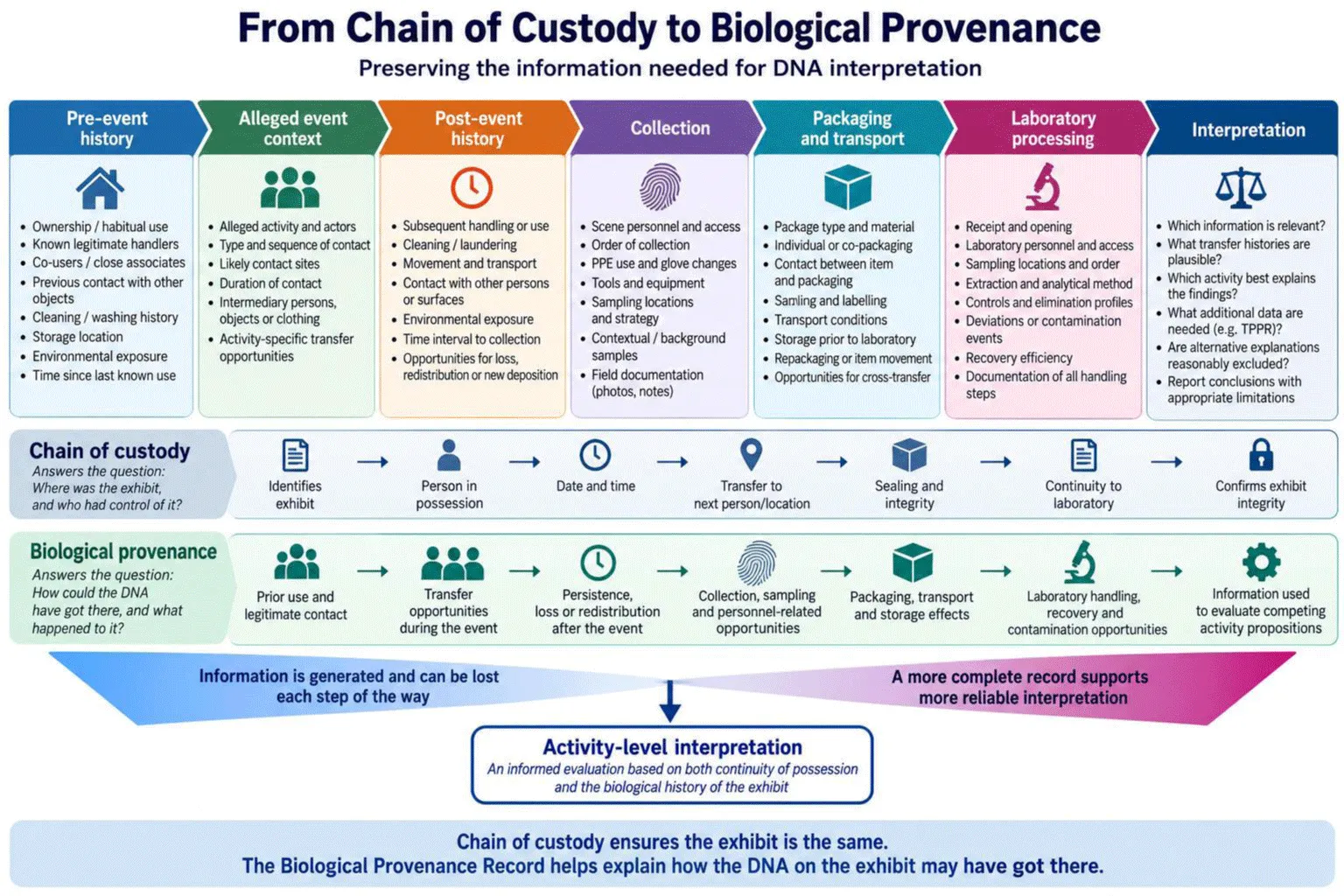
Figure 1: From chain of custody to biological provenance. Conceptual framework illustrating how conventional chain-of-custody documentation and the proposed Biological Provenance Record address different but complementary aspects of trace DNA evidence. Chain of custody primarily preserves exhibit identity, possession, transfer, timing, sealing, and continuity, whereas biological provenance captures the information needed to reconstruct how DNA may have been deposited, persisted, redistributed, contaminated, sampled, recovered, and ultimately interpreted. The framework organizes this information across seven stages: pre-event history, alleged-event context, post-event history, collection, packaging and transport, laboratory processing, and interpretation. At each stage, biologically relevant information may be generated, altered, or lost. The Biological Provenance Record is therefore intended to supplement, rather than replace, conventional chain of custody by preserving case information relevant to transfer, persistence, prevalence/background DNA, recovery, contamination, and competing activity propositions. Together, the two records provide a more complete basis for transparent activity-level interpretation.
The practical BPR is intentionally concise. Ten core entries span pre-event history, alleged-event and immediate post-event context, collection, packaging and transport, laboratory processing, and the current interpretive issue. Documentation should be proportionate to the case. A privately owned item with a simple history may require little detail; a shared garment, co-packaged exhibit, or repeatedly handled object may require substantially more. The objective is not maximal record keeping. It is preservation of information capable of changing proposition formulation, data relevance, or the interpretation of the resulting DNA findings.
Preserving evidential status and uncertainty
A central design feature is explicit information status. Material entries should be identified, where applicable, as observed or documented, reported, disputed, unknown, or not applicable. This prevents a witness account, investigative hypothesis, or defence explanation from acquiring the status of scientific fact merely because it appears in a laboratory record. It also preserves uncertainty as information. An undocumented glove-change sequence, for example, is not equivalent to evidence that gloves were not reused; 'unknown' must remain distinct from 'no opportunity'.
The record should also be version controlled because activity-level opinions are conditional on the propositions and information accepted for evaluation [3,14,15]. A later change in ownership, prior-use history, cleaning, access, timing, or handling may alter the relevant propositions or the suitability of supporting data. Retaining earlier versions allows reassessment without retrospectively rewriting the information base on which the original opinion was formed.
Relationship to quality records and contextual sampling
The BPR does not duplicate laboratory quality systems. Controls, elimination profiles, nonconformities, and contamination investigations remain governed by validated procedures. They enter biological provenance only when they bear on a case-specific post-event pathway. PPE documentation does not prove that contamination was prevented, and a clean control cannot exclude transfer occurring outside the process that control monitored [6,20-22,41]. The BPR therefore records information needed to evaluate a pathway without converting a procedural opportunity—or the absence of a detected problem—into a conclusion.
Contextual sampling is complementary for the same reason. Appropriately selected contextual samples can provide local information on background or prevalent DNA, but they answer a sampling question rather than reconstruct the broader biological history [48]. The BPR can preserve why such samples were collected, where and when they were obtained, and how they relate to the questioned item. This guards against treating a convenient comparison surface as representative background when its relationship to the disputed activity is weak or undefined.
Use in activity-level evaluation
The BPR is not an algorithm and does not generate a likelihood ratio. It supports the steps that precede qualitative or quantitative activity-level evaluation: formulating realistic competing propositions, defining the observations to be evaluated, selecting sufficiently comparable empirical data, recognizing dependence between samples or sites, and stating the conditioning information [3-5,13-15,49,50]. A transfer frequency estimated in one experiment or laboratory is not a universal probability. Donor structure, substrate, contact sequence, elapsed time, background conditions, packaging, sampling, and recovery determine whether published data are transportable to the case.
Its value may be greatest when quantification is not justified. The record can show that a strong source-level result is expected under undisputed legitimate use, identify a specific indirect-transfer route that merits evaluation, reveal that packaging undermines a spatial inference, or demonstrate that critical parameters are insufficiently documented for a defensible numerical LR. In each case, the benefit is not greater certainty. It is a better match between the scientific opinion, the propositions actually in dispute, and the information available to support them.
The BPR should be distinguished from, but is intended to complement, existing approaches to activity-level interpretation. Proposition-based guidance defines the inferential framework for evaluating findings, TPPR studies provide empirical data relevant to transfer, persistence, prevalence and recovery, contextual sampling can characterize case-specific background, and quality-system records document defined procedural events [3,6,13,48-52]. These approaches address different components of the interpretive process. The specific contribution of the BPR is the structured preservation and consolidation of proposition-relevant biological history across the life of an exhibit, together with the source, evidential status, uncertainty, and version history of that information. It is therefore intended to connect otherwise fragmented case information with later activity-level evaluation, not to replace existing evaluative models, quality systems, or sampling strategies.
The interpretive effect of biological provenance can be shown while holding the laboratory result constant. Assume that a complete or otherwise highly informative profile strongly supports Person A as a contributor to DNA recovered from an exhibit. That finding answers a contributor question. It does not identify when, how, or during which activity the DNA was deposited [1,3-5]. What changes across cases is the biological history against which the same observation must be evaluated and, consequently, which TPPR data are relevant to the competing propositions.
No documented prior association
If Person A has no documented ownership, use, or legitimate contact with the exhibit, event-related direct contact may be an important proposition to test, but it is not established by the profile. The BPR may identify intermediary persons or objects, scene access, packaging contacts, glove or tool pathways, and background conditions that support specified alternatives [9-12,20,21,35,36,40-43]. The task is to compare the complete findings under case-grounded histories, not to classify the profile abstractly as 'direct' or 'secondary'. Absence of a known prior association may weaken some alternatives factually; it does not transform source attribution into proof of direct or crime-related contact.
Habitual owner or legitimate user
If Person A owns or routinely uses the exhibit, the same profile may be expected before the alleged event. Repeated contact can create persistent reservoirs, and later users do not reliably replace DNA from habitual users [23-25]. The magnitude of the source-level association then does little to resolve the activity dispute. More informative features may include spatial distribution, additional contributors, negative samples, recent cleaning, and activity-specific contact sites. The relevant question becomes whether the complete findings discriminate the alleged event from prior legitimate use and persistence, not whether Person A's DNA is present.
Documented post-event transfer opportunity
A third case may contain a documented post-event pathway: joint packaging, substantial movement within packaging, handling after contact with another DNA-bearing item, or use of a glove or tool with a known preceding contact sequence. Such information does not establish transfer, but it changes which histories are scientifically grounded [9-12,20,21,40-44]. It can also change the meaning of location. DNA recovered from an apparently activity-specific region should not be assumed to have been deposited there if the post-event history provides a credible mechanism for site-to-site relocation [10,11,42,43].
These scenarios show why the BPR is interpretive infrastructure rather than a conclusion-generating device. The laboratory observation is unchanged; the conditional history is not. Direct event-related contact may be central in one case, pre-existing DNA expected in another, and a post-event pathway material in a third. None should be accepted merely because it is biologically possible. The BPR is intended to keep alternatives case-grounded, prevent generic transfer mechanisms from being invoked without factual support, and make clear when available TPPR data and assumptions are insufficient for robust quantification [3-5,13-15,49,50].
The same reasoning applies to negative and mixed findings. Non-detection at one site, an unknown contributor, or variation between adjacent samples may discriminate histories if those observations are predicted differently by the competing activities. Multiple positive samples, however, should not be treated automatically as independent support when they may arise from a common deposit, shared handler, co-packaging event, or transfer chain. By retaining sampling location, handling links, and recovery context, the BPR preserves the dependence structure of the evidence rather than reducing the case to disconnected DNA matches.
The framework therefore addresses an information problem, not an analytical deficiency. Modern workflows can generate technically strong profiles from small and complex deposits, yet their activity-level value depends on history distributed across scene notes, witness accounts, packaging records, laboratory worksheets, and quality documentation. Consolidating the minimum proposition-relevant elements into a BPR creates a traceable bridge between evidence handling and interpretation. Its utility remains to be tested prospectively; its immediate purpose is narrower—to reduce avoidable loss of biological-context information before the question changes from whose DNA was recovered to how that DNA may have arrived.
Scope and epistemic limits
The BPR is a proposed documentation framework, not a validated forensic standard. It cannot determine a transfer route, date a DNA deposit, establish contamination, or convert sparse TPPR evidence into a defensible numerical activity-level likelihood ratio. Nor can it recover information that was never observed or recorded. 'Unknown' must therefore remain an explicit state of knowledge, not be treated as evidence that no relevant contact or transfer opportunity existed. The framework is intended to make the information base transparent, not to create an appearance of completeness where the biological history remains uncertain.
More documentation is not necessarily better documentation. Relevance is case-dependent, and recording every conceivable contact or environmental event would increase burden without improving inference. BPR fields are prompts for information material to the disputed issue, not a requirement to evaluate every imaginable mechanism. A scientifically possible route becomes evidentially relevant only when it is sufficiently grounded in the case circumstances to form part of a meaningful competing history [3-5,15].
Documentation also cannot solve the scarcity or limited transportability of empirical data. Activity-level probabilities remain conditional on donor structure, substrate, contact sequence, background conditions, elapsed time, recovery, and laboratory workflow [13,39,49,50]. Inter-laboratory studies demonstrate material variation in recovery and dropout, and numerical results can change with the data structure or laboratory-specific information used [39,49,50]. The BPR can expose these mismatches and identify which conditions matter; it cannot make poorly matched data representative of the case.
Practical implementation
Implementation should be incremental and embedded within existing case-management processes rather than added as a parallel administrative system. A practical workflow would open the BPR at scene or case intake, update it when material information emerges, and retain version history through examination and reporting. Responsibility can be distributed: investigators record ownership, prior use, access, and alleged-event history; scene personnel document collection sequence, PPE, tools, and packaging; laboratory staff record sampling, controls, handling deviations, and recovery-relevant methodology. The evaluator must be able to identify both the source and evidential status of each material entry. At each update, material entries should be reconciled with the underlying scene, evidence-management, laboratory, or quality record rather than copied into an independent narrative; the BPR should retain the source of each entry, the date of update, and the version used for evaluation. Where discrepancies arise, both the discrepancy and its resolution or unresolved status should remain visible.
Access should also be staged. Analysts undertaking tasks that do not require activity-level context need not receive the full BPR, whereas evaluators comparing activities may require substantially more of the preserved history [6,18,19]. This separation retains information for later use without turning the record into a source of unnecessary contextual exposure. Where contextual samples are collected to characterize case-specific background DNA, the BPR should record their purpose, location, timing, and relationship to the questioned item rather than treating them as generic controls [48].
Validation before routine adoption
Prospective evaluation should test usability before evidential benefit is assumed. Initial outcomes could include completion time, the proportion of material fields recorded as unknown, inter-user consistency in classifying information as documented, reported, disputed, or not applicable, and the frequency with which BPR use identifies transfer or handling information absent from conventional records. Standardized case vignettes could test reproducibility of biological-history reconstruction; a prospective casework pilot could assess workload and whether the BPR changes proposition formulation, sampling decisions, requests for contextual information, or the need for re-evaluation when case facts change.
Claims that the BPR improves the accuracy or reliability of activity-level conclusions would require separate empirical testing. A controlled comparison of conventional documentation with BPR-assisted evaluation could examine completeness of proposition-relevant information, transparency of conditioning assumptions, recognition of dependence between samples, and consistency of evaluative reasoning, without treating agreement itself as proof of correctness. Input from investigators, scene personnel, scientists, and legal stakeholders would also be needed because current barriers to activity-level reporting include limited case-relevant data, training, standardized reporting, and legal acceptance [51,52].
The BPR should therefore be treated as a testable quality and information-preservation intervention. Chain of custody should continue to establish continuity and accountability for the exhibit; biological provenance should preserve the case information needed to decide what the DNA findings can legitimately support. Linking the two may reduce a specific and avoidable failure mode: a technically strong DNA result reaching the evaluative stage after the history needed to interpret it has already been lost.
The evidential strength of a DNA result is defined by the proposition it addresses. Strong source- or sub-source-level support may identify whose DNA was recovered while providing little discrimination between competing accounts of how, when, or during which activity it was deposited. Activity-level evaluation therefore requires a different information base: explicit competing histories, stated conditioning information, and sufficiently relevant TPPR data [1,3-5,15].
Chain of custody preserves the continuity and integrity of the exhibit; it does not necessarily preserve the biological history needed for that later evaluation. The proposed BPR addresses this gap by retaining the minimum information most capable of changing the expected DNA findings under competing activities, including prior use, legitimate handlers, cleaning, subsequent contact, collection sequence, PPE and tools, packaging, sampling location, laboratory handling, and recovery conditions [1,6,9-11]. Its role is not to reconstruct the event or privilege an explanation, but to preserve the information required to evaluate specified explanations transparently.
Its central scientific discipline is to separate possibility, case relevance, and probability. A documented transfer opportunity does not establish that transfer occurred; a clean control does not exclude every exhibit-specific contamination route; and a biologically plausible alternative should not enter an evaluation merely because it can occur. Conversely, missing provenance should remain visible as uncertainty rather than being interpreted as absence of an alternative pathway. This distinction matters because recovery and activity-level probabilities vary with laboratory, substrate, sampling strategy, and scenario design [13,49,50].
The BPR is therefore an information-preservation framework, not a validated evaluative model. Its adoption should depend on prospective evidence that it is usable, proportionate, reproducible, and capable of improving proposition formulation and the transparency of conditioning assumptions without unnecessary contextual exposure. Contextual sampling, quality-system records, and activity-level models remain distinct but complementary tools [48,51,52]. Validation would not remove biological uncertainty; it would make the history on which that uncertainty depends more explicit and reviewable.
In practical terms, chain of custody establishes continuity of the exhibit; biological provenance preserves continuity of the information needed to interpret the DNA on it. Linking those functions may help ensure that increasing analytical sensitivity is matched by equally rigorous preservation of the evidential context required to determine what a trace DNA finding can—and cannot—support.
The author acknowledges the institutional and professional environment that supported the development of this work and thanks colleagues in forensic science whose general scientific discussions helped refine the concepts presented.
Conflict of interest: The author declares no conflict of interest.
Ethics statement: Ethical approval was not required because this article synthesizes published literature and involved no new recruitment of human participants, collection of biological samples, or access to identifiable personal data.
Author contributions
Salem K. Alketbi conceived the article, developed the conceptual and interpretive framework, reviewed and synthesized the relevant literature, prepared the figure and table, and drafted and critically revised the manuscript.
Data availability statement: Not applicable. No new datasets were generated or analysed for this article.
Funding: This work received no specific funding.
- Alketbi SK. DNA at the scene does not mean DNA from the crime: A practical review of transfer, background DNA, contamination, and forensic interpretation. Int J Sci Res Arch. 2026;20(03):211‑279. Available from: https://dx.doi.org/10.30574/ijsra.2026.20.3.1726.
- Gill P, Hicks T, Butler JM, Connolly E, Gusmao L, Kokshoorn B, et al. DNA Commission of the International Society for Forensic Genetics: Assessing the value of forensic biological evidence – Guidelines highlighting the importance of propositions. Part I: evaluation of DNA profiling comparisons given (sub‑)source propositions. Forensic Sci Int Genet. 2018;36:189‑202. Available from: https://dx.doi.org/10.1016/j.fsigen.2018.07.003.
- Gill P, Hicks T, Butler JM, Connolly E, Gusmao L, Kokshoorn B, et al. DNA Commission of the International Society for Forensic Genetics: Assessing the value of forensic biological evidence – Guidelines highlighting the importance of propositions. Part II: evaluation of biological traces considering activity‑level propositions. Forensic Sci Int Genet. 2020;44:102186. Available from: https://dx.doi.org/10.1016/j.fsigen.2019.102186.
- van Oorschot RAH, Szkuta B, Meakin GE, Kokshoorn B, Goray M. DNA transfer in forensic science: A review. Forensic Sci Int Genet. 2019;38:140‑166. Available from: https://dx.doi.org/10.1016/j.fsigen.2018.10.014.
- Taylor D, Kokshoorn B, Biedermann A. Evaluation of forensic genetics findings given activity level propositions: A review. Forensic Sci Int Genet. 2018;36:34‑49. Available from: https://dx.doi.org/10.1016/j.fsigen.2018.06.001.
- National Institute of Standards and Technology. Forensic DNA interpretation and human factors: Improving the practice through a systems approach. NIST IR 8503. 2024. Available from: https://dx.doi.org/10.6028/nist.ir.8503.
- European Network of Forensic Science Institutes (ENFSI). ENFSI guideline for evaluative reporting in forensic science. Approved version 3.0. 2015.
- European Network of Forensic Science Institutes (ENFSI). Best practice manual for the forensic examination of DNA. ENFSI‑BPM‑DNA‑03. 2022.
- Alketbi SK. Maintaining the chain of custody: Anti‑contamination measures for trace DNA evidence. Int J Sci Res Arch. 2023;8(2):457‑461. Available from: https://dx.doi.org/10.30574/ijsra.2023.8.2.0257.
- Goray M, van Oorschot RAH, Mitchell RJ. DNA transfer within forensic exhibit packaging: Potential for DNA loss and relocation. Forensic Sci Int Genet. 2012;6(2):158‑166. Available from: https://dx.doi.org/10.1016/j.fsigen.2011.03.013.
- Fonnelop AE, Johannessen H, Egeland T, Gill P. Contamination during criminal investigation: Detecting police contamination and secondary DNA transfer from evidence bags. Forensic Sci Int Genet. 2016;23:121‑129. Available from: https://dx.doi.org/10.1016/j.fsigen.2016.04.003.
- Goray M, Pirie E, van Oorschot RAH. DNA transfer: DNA acquired by gloves during casework examinations. Forensic Sci Int Genet. 2019;38:167‑174. Available from: https://dx.doi.org/10.1016/j.fsigen.2018.10.018.
- Gill P, Hicks T, Kokshoorn B, van Oorschot RAH, Taylor D, Parson W. Minimum FSI: Genetic requirements for publishing data on DNA transfer and recovery, given activities. Forensic Sci Int Genet. 2026;80:103330. Available from: https://dx.doi.org/10.1016/j.fsigen.2025.103330.
- Kokshoorn B, Blankers BJ, de Zoete J, Berger CEH. Activity level DNA evidence evaluation: On propositions addressing the actor or the activity. Forensic Sci Int. 2017;278:115‑124. Available from: https://dx.doi.org/10.1016/j.forsciint.2017.06.029.
- Biedermann A, Champod C, Jackson G, Gill P, Taylor D, Butler J, et al. Evaluation of forensic DNA traces when propositions of interest relate to activities: Analysis and discussion of recurrent concerns. Front Genet. 2016;7:215.
- Alketbi SK, Goodwin W, Alghanim HJ, Abdullahi AA, Aidarous NI, Alawadhi HM, et al. Trace DNA recovery: insights from Dubai Police casework. Perspect Leg Forensic Sci. 2025;2:10001. Available from: https://dx.doi.org/10.70322/plfs.2025.10001.
- Hoffmann R, Roux C, Meakin GE, Daubney J, Nadort A, Sears A, Morelato M. The added value of trace DNA in an investigative context. Forensic Sci Int. 2026;388:113070. Available from: https://dx.doi.org/10.1016/j.forsciint.2026.113070.
- Jeanguenat AM, Budowle B, Dror IE. Strengthening forensic DNA decision-making through a better understanding of the influence of cognitive bias. Sci Justice. 2017;57(6):415‑20. Available from: https://dx.doi.org/10.1016/j.scijus.2017.07.005.
- Dror IE, Hampikian G. Subjectivity and bias in forensic DNA mixture interpretation. Sci Justice. 2011;51(4):204‑8. Available from: https://dx.doi.org/10.1016/j.scijus.2011.08.004.
- Alketbi SK. DNA contamination in crime scene investigations: common errors, best practices, and insights from a survey study. Biomed J Sci Tech Res. 2024;58(5). Available from: https://dx.doi.org/10.26717/bjstr.2024.58.009223.
- Alketbi SK, Carta L. Safeguarding DNA integrity: the critical role of PPE in preventing contamination in forensic laboratories. J Forensic Sci Crim Investig. 2025;19(2):556010. Available from: https://dx.doi.org/10.19080/jfsci.2025.19.556010.
- Abdullahi AA, Alketbi SK. Implementation reliability in forensic DNA contamination prevention: a human‑factor quality‑systems mini review. Med Res Arch. 2026;14(7):1‑18. Available from: https://dx.doi.org/10.18103/mra.2026.0388.
- Szkuta B, Ballantyne KN, Kokshoorn B, van Oorschot RAH. Transfer and persistence of non‑self DNA on hands over time: using empirical data to evaluate DNA evidence given activity level propositions. Forensic Sci Int Genet. 2018;33:84‑97. Available from: https://dx.doi.org/10.1016/j.fsigen.2017.11.017.
- Meakin GE, Butcher EV, van Oorschot RAH, Morgan RM. Trace DNA evidence dynamics: an investigation into the deposition and persistence of directly‑ and indirectly‑transferred DNA on regularly‑used knives. Forensic Sci Int Genet. 2017;29:38‑47. Available from: https://dx.doi.org/10.1016/j.fsigen.2017.03.016.
- Atkinson K, Arsenault H, Taylor C, Volgin L, Millman J. Transfer and persistence of DNA on items routinely encountered in forensic casework following habitual and short‑duration one‑time use. Forensic Sci Int Genet. 2022;60:102737. Available from: https://dx.doi.org/10.1016/j.fsigen.2022.102737.
- Alketbi SK. The affecting factors of Touch DNA. J Forensic Res. 2018;9(3):424. Available from: https://dx.doi.org/10.4172/2157‑7145.1000424.
- Alketbi SK, Ahmed SR. Influence of physiological activation on Touch DNA deposition and STR profile quality during competitive computer gaming: a forensic pilot study. Forensic Sci Int Genet. 2027;87:103599. Available from: https://dx.doi.org/10.1016/j.fsigen.2026.103599.
- Alketbi SK, Goodwin W. Temporal assessment of DNA shedding from human hands after handwashing: implications for Touch DNA recovery. Biomed J Sci Tech Res. 2024;59(5). Available from: https://dx.doi.org/10.26717/bjstr.2024.59.009365.
- Alketbi SK. Fingernail samples as DNA reservoirs: implications for forensic interpretation. World J Adv Res Rev. 2026;30(1):1154‑85. Available from: https://dx.doi.org/10.30574/wjarr.2026.30.1.0913.
- Alketbi SK, Goodwin W. The impact of deposition area and time on Touch DNA collected from fabric. Forensic Sci Int Genet Suppl Ser. 2022;8:45‑7. Available from: https://dx.doi.org/10.1016/j.fsigss.2022.09.017.
- Alketbi SK, Goodwin W. The effect of time and environmental conditions on touch DNA. Forensic Sci Int Genet Suppl Ser. 2019;7:701‑3. Available from: https://dx.doi.org/10.1016/j.fsigss.2019.10.144.
- Singh VS, Alketbi SK, Sharma PA. Influence of surface material, cleaning frequency and swab type on touch DNA recovery from entrance door handles: a simulated study. Int J Forens Sci. 2025;10(4):000449. Available from: https://dx.doi.org/10.23880/ijfsc-16000449.
- Chahal RB, Alketbi SK. Touch DNA on wood: effects of surface morphology, humidity, and adaptive recovery strategies on forensic DNA yield. Int J Forens Sci. 2026;11(1):000453. Available from: https://dx.doi.org/10.23880/ijfsc-16000453.
- Alketbi SK, Goodwin W. Evaluating the impact of sandy surface contamination on trace DNA recovery from wearable fabrics: a comparative study of collection methods and extraction kits. World J Adv Res Rev. 2025;26(3):2399‑410. Available from: https://dx.doi.org/10.30574/wjarr.2025.26.3.2441.
- McCrane SM, Mulligan CJ. An innovative transfer DNA experimental design and qPCR assay to identify primary, secondary, and tertiary DNA transfer. J Forensic Sci. 2024;69(2):618‑30. Available from: https://dx.doi.org/10.1111/1556-4029.15444.
- Fonnelop AE, Egeland T, Gill P. Secondary and subsequent DNA transfer during criminal investigation. Forensic Sci Int Genet. 2015;17:155‑62. Available from: https://dx.doi.org/10.1016/j.fsigen.2015.05.009.
- Alketbi SK. Collection techniques of touch DNA deposited on human skin following a strangulation scenario. Int J Legal Med. 2023;137:1357‑62. Available from: https://dx.doi.org/10.1007/s00414-023-03036-8.
- Alketbi SK, Carta L. Uncovering the persistence of touch DNA on human skin and its implications for violent crime investigations. World J Biol Pharm Health Sci. 2025;21(3):234‑44. Available from: https://dx.doi.org/10.30574/wjbphs.2025.21.3.0270.
- Szkuta B, Ansell R, Boiso L, Connolly E, Kloosterman AD, Kokshoorn B, McKenna LG, Steensma K, van Oorschot RAH. Assessment of the transfer, persistence, prevalence and recovery of DNA traces from clothing: an inter‑laboratory study on worn upper garments. Forensic Sci Int Genet. 2019;42:56‑68. Available from: https://dx.doi.org/10.1016/j.fsigen.2019.06.011.
- Mehta AA, Alketbi SK. Touching without contact: glove‑mediated secondary DNA transfer in forensic casework. J Forensic Allied Sci. 2025;1(1):56‑72. Available from: https://dx.doi.org/10.64475/jfas.vol.1.issue1.8.
- Carson S, Volgin L, Abarno D, Taylor D. The potential for investigator‑mediated contamination to occur during routine search activities. Forensic Sci Med Pathol. 2022;18(3):299‑310. Available from: https://dx.doi.org/10.1007/s12024‑022‑00465‑6.
- Taylor D, Volgin L, Kokshoorn B. Accounting for site‑to‑site DNA transfer on a packaged exhibit in an evaluation given activity level propositions. Forensic Sci Int Genet. 2024;73:103122. Available from: https://dx.doi.org/10.1016/j.fsigen.2024.103122.
- Stella CJ, Goray M, Meakin GE, van Oorschot RAH. DNA transfer in packaging: investigation of mitigation strategies. J Forensic Sci. 2026;71:197‑210. Available from: https://dx.doi.org/10.1111/1556‑4029.70217.
- Mercer C, Taylor D, Henry J, Linacre A. DNA accumulation and transfer within an operational forensic exhibit storeroom. Forensic Sci Int Genet. 2023;62:102799. Available from: https://dx.doi.org/10.1016/j.fsigen.2022.102799.
- Alketbi SK, Goodwin W. The effect of surface type, collection and extraction methods on touch DNA. Forensic Sci Int Genet Suppl Ser. 2019;7:704‑6. Available from: https://dx.doi.org/10.1016/j.fsigss.2019.10.145.
- Singh HP, Alketbi SK. Influence of non‑porous surface morphology on DNA recovery efficiency and STR profile quality using common forensic swabbing techniques. Biomed J Sci Tech Res. 2026;65(5). Available from: https://dx.doi.org/10.26717/bjstr.2026.65.010242.
- Alketbi SK, Ali MS, Khan SA. Managing porous substrate wicking in trace DNA collection: impact of swab wetting volume on fabric evidence. Med Res Arch. 2026;14(2). Available from: https://dx.doi.org/10.18103/mra.v14i2.6610.
- Goedhart YR, de Koeijer JA, Aarts LHJ, de Poot CJ, Kokshoorn B. Contextual DNA samples in evaluations given activity level propositions. Forensic Sci Int Genet. 2026;84:103452. Available from: https://dx.doi.org/10.1016/j.fsigen.2026.103452.
- Gill P, Fonnelop AE, Hicks T, et al. The ReAct project: analysis of data from 23 different laboratories to characterise DNA recovery given two sets of activity level propositions. Forensic Sci Int Genet. 2025;76:103222. Available from: https://dx.doi.org/10.1016/j.fsigen.2025.103222.
- Taylor D, Volgin L, Gill P, Kokshoorn B. Accounting for inter‑laboratory DNA recovery data variability when performing evaluations given activities. Forensic Sci Int Genet. 2025;78:103283. Available from: https://dx.doi.org/10.1016/j.fsigen.2025.103283.
- Prinz M, Pirtle D, Oldoni F. Global survey on evaluative reporting on DNA evidence about activity‑level propositions. J Forensic Sci. 2024;69(3):798‑813. Available from: https://dx.doi.org/10.1111/1556‑4029.15488.
- Buckleton J, Taylor D, Allen PS, Curran J, Kalafut T. Reporting the value of biological findings given activity level propositions: A discussion of published recommendations. J Forensic Sci. 2025;70(5):1670‑1686. Available from: https://dx.doi.org/10.1111/1556‑4029.70112.