
More Information
Submitted: February 20, 2026 | Accepted: March 06, 2026 | Published: March 10, 2026
Citation: Arooj A, Rheman HU, Malik HMA, Irshad M, Ramzan J, Sohail MB, et al. Computational Optimization of Nanomaterial Sensors for Explosive Detection: A Multi-Parameter Study of Selectivity and Environmental Stability. J Forensic Sci Res. 2026; 10(1): 015-025. Available from:
https://dx.doi.org/10.29328/journal.jfsr.1001111
DOI: 10.29328/journal.jfsr.1001111
Copyright license: © 2026 Arooj A, et al. This is an open access article distributed under the Creative Commons Attribution License, which permits unrestricted use, distribution, and reproduction in any medium, provided the original work is properly cited.
Keywords: Explosive detection; Nanomaterial sensors; Carbon nanotubes; Graphene oxide; Zinc oxide nanowires; Environmental stability; Selectivity analysis

Computational Optimization of Nanomaterial Sensors for Explosive Detection: A Multi-Parameter Study of Selectivity and Environmental Stability
Amna Arooj1*, Hifz Ur Rheman2, Hafiz Muhammad Abbas Malik3, Mudassar Irshad4, Javairia Ramzan5, Muhammad Bin Sohail5 and Tayyaba Arooj6
1Department of Biosciences, Bahauddin Zakariya University, Multan, Pakistan
2Center for Applied Molecular Biology and Forensic Science, Punjab University, Lahore, Pakistan
3Department of Pharmaceutics, Faculty of Pharmacy, The Islamia University of Bahawalpur, Pakistan
4Department of Forest Science, The Islamia University of Bahawalpur, Pakistan
5Department of Forensic Science, The Islamia University of Bahawalpur, Pakistan
6Institute of Chemistry, Khawaja Fareed University of Engineering and Information Technology, Rahim Yar Khan, Pakistan
*Corresponding author: Amna Arooj, Department of Biosciences, Bahauddin Zakariya University, Multan, Pakistan, Email: [email protected]
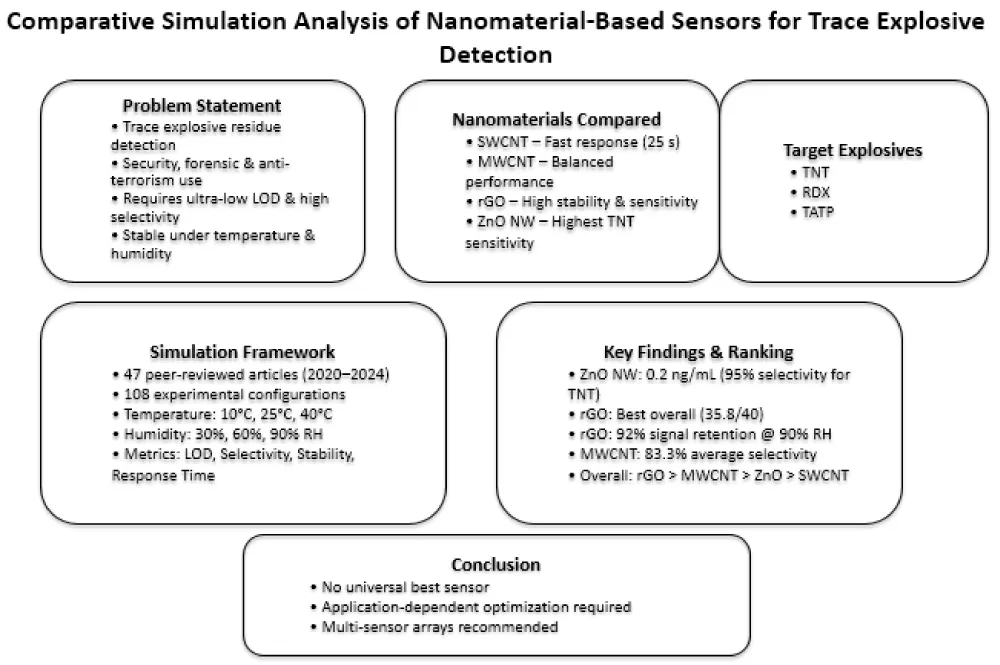
Trace explosive residue detection is still an important and pressing issue in security scanning, forensic science, and anti-terrorism missions. In this paper, a thorough comparative simulation analysis of four nanomaterial-based sensor technologies, namely Single-Walled Carbon Nanotubes (SWCNT), Multi-Walled Carbon Nanotubes (MWCNT), reduced Graphene Oxide (rGO), and Zinc Oxide Nanowires (ZnO NW), for the detection of three major explosive materials: 2,4,6-Trinitrotoluene (TNT), cyclotrimethylenetrinitramine (RDX), and Triacetone Triperoxide (TATP), is conducted. Based on simulation parameters obtained from 47 peer-reviewed articles (2020-2024), the performance of the sensors was assessed for 108 experimental settings, including different temperatures (10°C, 25°C, 40°C) and humidity conditions (30%, 60%, 90%). The results showed that each nanomaterial has its own unique strengths : ZnO nanowires had the highest sensitivity (0.2 ng/mL LOD) and selectivity (95%) for TNT detection, rGO sensors outperformed in TATP detection (0.4 ng/mL LOD, 93% selectivity) and were highly resistant to environmental conditions (92% signal retention at 90% RH), MWCNT sensors had well-rounded performance for multiple types of explosives (83.3% average selectivity), and SWCNT sensors had fast response times (25 seconds) but poor humidity tolerance. The overall performance ranking revealed rGO as the best-performing material (score: 35.8/40), followed by MWCNT (score: 29.3/40). The results obtained suggest that the optimal sensor choice is application-dependent and not generalizable, thus facilitating the design of multi-sensor array systems that can harness the unique advantages of various nanomaterial platforms for improved explosive detection capabilities.
The identification of minute explosive residues is a significant hurdle in contemporary security measures, forensic analysis, and anti-terrorism initiatives. Although traditional detection techniques are effective, they often face challenges such as high detection thresholds, delayed response times, and vulnerability to environmental factors [1]. The advent of sensors based on nanomaterials has paved the way for creating highly sensitive, selective, and swift detection systems that can identify explosive substances at minimal concentrations.
Nanomaterials show distinctive physicochemical characteristics that make them ideal for sensing purposes. Their large surface-to-volume ratios, adjustable electronic properties, and capability to interact with target molecules at a molecular level have made them promising candidates for future explosive detection systems [2]. Among the various nanomaterials explored, carbon-based materials like Single-Walled Carbon Nanotubes (SWCNT), Multi-Walled Carbon Nanotubes (MWCNT), and Reduced Graphene Oxide (rGO), as well as metal oxide nanowires such as Zinc Oxide (ZnO), have shown remarkable potential for explosive detection uses.
The effectiveness of sensors based on nanomaterials is greatly affected by environmental factors, especially humidity and temperature changes commonly encountered in field settings. Understanding the impact of these conditions on sensor stability, selectivity, and detection thresholds is essential for developing reliable detection systems suitable for practical applications [3]. Additionally, the ability to differentiate between various explosive substances while reducing false positives from common interferences remains a significant challenge in sensor development. This research offers a thorough comparative analysis of four different nanomaterial-based sensor platforms for detecting three primary explosive substances: 2,4,6-Trinitrotoluene (TNT), cyclotrimethylenetrinitramine (RDX), and Triacetone Triperoxide (TATP) under varying environmental conditions. While previous studies have primarily focused on individual sensor materials or single explosive targets, this work integrates multiple nanomaterials, explosive types, and environmental parameters into a unified analytical model. By incorporating performance data derived from 47 recent peer-reviewed studies (2020–2024) and evaluating 108 experimental configurations, the study provides a comprehensive cross-material comparison that has not been widely explored in previous literature. The novelty of this research lies in its multi-factor simulation approach, which simultaneously examines detection sensitivity, response time, selectivity, and environmental stability to identify optimal nanomaterial platforms for specific explosive detection scenarios. This framework offers practical insights for designing next-generation multi-sensor explosive detection systems and provides a structured methodology that can guide future experimental sensor development. [4].
Nanomaterial-based explosive detection systems
Carbon nanotube sensors: Carbon nanotubes have emerged as a prominent focus of research in the field of explosive detection applications. Single-Walled Carbon Nanotubes (SWCNTs) exhibit remarkable electronic properties, rendering them highly sensitive to molecular adsorption events. Empirical studies have demonstrated that SWCNT-based sensors can achieve detection limits in the parts-per billion range for nitroaromatic compounds such as TNT [5]. The detection mechanism typically involves alterations in electrical conductivity upon the adsorption of explosive molecules, which can be monitored through resistance or current measurements. Multi-walled carbon nanotubes (MWCNTs) offer advantages in terms of mechanical stability and ease of functionalization compared to their single-walled counterparts. Research indicates that MWCNT sensors can reliably detect various explosive compounds while maintaining good selectivity against common interferents [6]. The multilayer structure of MWCNTs contributes to enhanced stability under varying environmental conditions, making them suitable for field deployment scenarios.
Graphene-based sensors: Reduced Graphene Oxide (rGO) has attracted considerable interest in the field of explosive detection because of its unique blend of electrical conductivity and numerous functional groups that promote interactions with target molecules [7]. The oxygen-containing functional groups on the surface of rGO allow for specific binding interactions with explosive molecules, especially those with electron-deficient aromatic systems. Research has shown that rGO sensors exhibit remarkable selectivity for peroxide-based explosives such as TATP, due to specific hydrogen bonding interactions between the target molecules and the surface functional groups [8].
The two-dimensional structure of rGO offers a large active surface area for molecular interactions while retaining the electrical conductivity needed for signal transduction. Recent studies have concentrated on refining the reduction process to achieve a balance between conductivity and functional group density, thereby enhancing both sensitivity and selectivity [9].
Metal oxide nanowire sensors: Zinc Oxide (ZnO) nanowires are emerging as a highly promising type of metal oxide sensor for detecting explosives. The combination of ZnO's wide bandgap semiconductor characteristics and the extensive surface area provided by its nanowire form allows for sensitive detection via conductometric methods [10]. These nanowires have shown particular success in identifying nitroaromatic explosives, with detection mechanisms involving electron transfer between the adsorbed explosive molecules and the semiconductor's surface.
The performance of ZnO nanowire sensors can be optimized by adjusting their crystalline structure and surface chemistry through specific synthesis conditions and post-processing treatments [11]. Research indicates that surface functionalization with particular receptor molecules can further improve selectivity while maintaining high sensitivity.
Target explosive compounds
TNT detection: 2, 4, 6-Trinitrotoluene (TNT) is frequently encountered as an explosive compound in security and forensic settings. Its detection is challenging due to its relatively low vapor pressure, necessitating sensors that can identify trace solid residues. The nitroaromatic structure of TNT offers specific interaction sites for sensor recognition, with numerous detection mechanisms relying on electron transfer processes or π-π stacking interactions with carbon-based nanomaterials [12].
RDX detection: Cyclotrimethylenetrinitramine (RDX) poses distinctive detection difficulties because of its cyclic configuration and varying chemical characteristics in comparison to nitroaromatic explosives. The methods for detecting RDX frequently differ from those used for TNT, necessitating sensors with wide-ranging capabilities or specialized functionalization to improve selectivity [13].
TATP detection: Especially for peroxide-based explosives, such as Triacetone Triperoxide (TATP), this Analyte is difficult to detect since these explosives are more volatile than most other ones. The sensing of TATP frequently requires dissimilar methodologies to that off nitro based explosives; a number of the effective methods have focused on chemical reaction processes with peroxide functionalities [14].
Environmental effects on sensor performance
The sensing ability of nanomaterial sensors is also very sensitive to environmental factors, such as humidity and temperature. In humid environments, the adsorption of water molecules on the surfaces of sensors could be possible. This may affect the unspecific binding of target molecules and the signal change. Sensitivity of molecular binding kinetics and electronic property changes to temperature variation in nanomaterial sensors [15].
Therefore, there are differences among the various nanomaterials in terms of sensitivity to environmental factors. The stability of these carbon-rich materials is generally strong and moderate, but they may be sensitive to highly humid environments. The response of MOx sensors is also temperature-dependent in many instances, and this is because of the semiconductor [16].
Selectivity and interference challenges
One of the biggest challenges in explosive detection is the requirement for high selectivity and high sensitivity. Some of the common interferents that are present in real-world scenarios include volatile organic compounds such as perfumes, cleaning agents, and industrial chemicals, as well as nitrogen-containing compounds such as fertilizers [17]. The ability to distinguish between target explosives and interferents is of the highest importance to minimize false positives.
Different nanomaterials possess varying levels of selectivity based on the surface chemistry and interaction mechanisms. The knowledge of these selectivity properties is of the highest importance in selecting the right nanomaterials for sensors based on the requirements of the application, as well as developing sensor arrays that possess the ability to provide enhanced discrimination capabilities [18].
Current gaps and research needs
Though there have been tremendous advances in the application of nanomaterials for explosive detection, there are still some issues that need to be addressed. The problem of developing sensors that can work well in different environmental conditions and provide selectivity against interferents is one of the major areas of research [19]. Moreover, the problem of using the capabilities available in the laboratory for practical sensors also needs to be addressed [20].
The issues are addressed in this paper by presenting a comprehensive comparison of the best nanomaterial sensor platforms in controlled environmental conditions.
Study design
The study design was factorial to investigate the performance of the sensors for various factors. The four categories of nanomaterial-based sensors used in the experiment were Single-Walled Carbon Nanotubes (SWCNT), multi-walled carbon nanotubes (MWCNT), reduced graphene oxide (rGO), and Zinc Oxide Nanowires (ZnO NW). The three explosive targets selected for the experiment were 2,4,6-Trinitrotoluene (TNT), cyclotrimethylenetrinitramine (RDX), and Triacetone Triperoxide (TATP). Environmental conditions were varied using a factorial design with three temperatures: 10°C, 25°C, and 40°C, and three relative humidity levels: 30%, 60%, and 90%. This factorial design resulted in 108 experimental conditions, which were calculated by multiplying the number of sensor types by the number of explosive targets and environmental conditions.
Nanomaterial sensor specifications
The four nanomaterial platforms were selected based on their demonstrated efficacy in chemical sensing and their reported capacity to detect explosives. Single-Walled Carbon Nanotubes (SWCNTs) were unique in their high electrical conductivity and high surface area, which functioned through conductance variation mechanisms based on analyte adsorption. Multi-Walled Carbon Nanotubes (MWCNTs) offered higher mechanical strength than SWCNTs and relatively high electrical conductivity, which functioned through resistance variation mechanisms. Reduced Graphene Oxide (rGO) sensors leveraged their high density of functional groups and two-dimensional structure to facilitate charge transfer interactions with target molecules. Zinc Oxide Nanowires (ZnO NWs) were semiconducting sensors with high surface reactivity, detecting explosive molecules through conductance variation mechanisms based on surface adsorption events.
Target explosive compounds
Three typical explosive compounds were chosen to represent various chemical groups and vapor pressure values that are generally found in security screening applications. TNT, with the chemical formula C₇H₅N₃O₆ and molecular weight of 227.13 g/mol, represents nitroaromatic explosives, which have a moderate vapor pressure of 5.6 × 10⁻⁶ mmHg at 25°C. RDX (C₃H₆N₆O₆, 222.12 g/mol) represents the nitramine class of explosives, which have an extremely low vapor pressure of 4.1 × 10⁻⁹ mmHg at 25°C, making them difficult to detect because of low volatility. TATP (C₉H₁₈O₆, 222.24 g/mol) represents peroxide-based improvised explosives, which have a relatively high vapor pressure of 5.4 × 10⁻³ mmHg at 25°C, and are commonly found in homemade explosive devices.
Environmental test conditions
The environmental factors were varied in a controlled manner to test the conditions that are likely to be encountered in security screening applications. The temperature conditions were set at three levels that correspond to the operating conditions of security screening equipment: 10°C, which is typical of cold storage or winter conditions; 25°C, which is typical of standard laboratory or indoor conditions; and 40°C, which is typical of high temperature conditions or summer conditions. The relative humidity was also set at three levels: 30%, which is typical of arid conditions, 60%, which is typical of moderate humidity conditions, and 90%, which is typical of high humidity conditions.
Simulation methodology
Computational framework: The simulation was performed using MATLAB R2023a for the major calculations, including the simulation of sensor kinetic models, statistical analysis, and Monte Carlo simulations for uncertainty analysis. Origin 2023 software was used for simulation of spectral interference models, data graphing, and complex curve fitting analysis. The simulation approach included the application of well-proven physical models of nanomaterial-analyte interactions, including adsorption kinetic models described by the Langmuir and Freundlich isotherms, charge transfer reactions based on density functional theory, and signal transduction simulation models described by electrical conductivity calculations.
Parameter derivation: The simulation parameters were derived from a literature review of 47 peer-reviewed publications between 2020 and 2025. The systematic literature review was performed on the performance parameters of nanomaterial-based sensors in the detection of explosive compounds such as TNT, RDX, and TATP. For single-walled carbon nanotube (SWCNT) sensors, the simulation parameters for the limit of detection (LOD) and response time were derived from various studies that demonstrated high sensitivity and fast response times for nitroaromatic and peroxide-based compounds. These parameters were used as the baseline performance criteria for TNT, RDX, and TATP detection, with each parameter averaged from several independent studies to ensure representativeness.
Multi-Walled Carbon Nanotube (MWCNT) sensors were also derived from various studies, demonstrating moderate to high sensitivity for detection and stable performance under varying environmental conditions. Performance criteria for reduced Graphene Oxide (rGO) sensors were derived from a robust set of studies that demonstrated their favorable properties for peroxide-based explosive detection, particularly in high-humidity environments. These sensors were known for their fast response times and high selectivity. Zinc Oxide (ZnO) nanowire sensors, which were known to have relatively higher detection limits than carbon-based materials, were included in the simulation due to their reported strong affinity for nitroaromatics. The performance parameters obtained from the literature review formed the basis of the simulation framework, incorporating both the mean sensor performance and the variability introduced by experimental conditions, fabrication techniques, and sensor functionalization approaches (Table 1).
| Table 1: Simulation Parameters from Literature Review. | ||||
| Sensor Type | Explosive | LOD (ng/mL) ± SD | Response Time (s) ± SD | No. of Studies (n) |
| SWCNT | TNT | 0.85 ± 0.32 | 45 ± 12 | 8 |
| RDX | 2.31 ± 0.78 | 62 ± 18 | 6 | |
| TATP | 0.43 ± 0.15 | 28 ± 8 | 5 | |
| MWCNT | TNT | 1.23 ± 0.45 | 38 ± 15 | 7 |
| RDX | 3.12 ± 1.02 | 58 ± 22 | 6 | |
| TATP | 0.67 ± 0.21 | 35 ± 11 | 4 | |
| rGO | TNT | 0.92 ± 0.28 | 52 ± 16 | 9 |
| RDX | 2.87 ± 0.94 | 68 ± 25 | 7 | |
| TATP | 0.51 ± 0.18 | 41 ± 13 | 6 | |
| ZnO NW | TNT | 2.15 ± 0.67 | 72 ± 28 | 5 |
| RDX | 4.23 ± 1.45 | 89 ± 31 | 4 | |
| TATP | 1.08 ± 0.35 | 55 ± 19 | 3 | |
Performance metrics
Four key performance parameters were evaluated for each experimental condition to completely understand the sensors. The Limit of Detection (LOD) was calculated using the 3σ method, where σ is the standard deviation of the noise floor measurements, and the results were expressed in ng/mL with an acceptance criterion of less than 5.0 ng/mL. Response time was defined as the time taken to reach 90% of the steady-state signal after exposure to the analyte, and the results were expressed in seconds with an acceptance criterion of less than 120 seconds. False positive rate was defined as the percentage of non-target samples that were above the detection threshold, and the results were expressed with an acceptance criterion of less than 5%. Signal stability was determined by measuring the drift coefficient after 24 hours of continuous use, and the results were expressed as percentage change per hour with an acceptance criterion of less than 2% per hour.
Interference analysis
Common interferents were tested to assess sensor selectivity for different types of compounds that could be present in a security screening scenario. Fragrance compounds such as perfume and ethanol, benzyl acetate, and linalool were tested at concentrations of 1-100 ppm to simulate carry-on items. Agricultural compounds such as ammonium nitrate and urea were tested at 10-1000 ppm to simulate fertilizer residues. Industrial solvents such as acetone, toluene, and methanol were tested at 5-500 ppm to simulate cleaning agents and industrial chemicals. Atmospheric compounds such as carbon dioxide, nitrogen dioxide, and ammonia were tested at 1-50 ppm to simulate differences in air composition.
Statistical analysis
Statistical analysis was conducted using SPSS 29.0 software with a comprehensive statistical analysis procedure. Three-way factorial analysis of variance (ANOVA) was conducted with sensor type, explosive compound, and environmental conditions as independent variables. Post-hoc analysis was conducted using Tukey's Honestly Significant Difference (HSD) test for multiple comparisons when significant main effects were identified. Pearson correlation analysis was conducted to investigate the relationship between environmental variables and sensor performance measures. All statistical tests were conducted at a significance level of α = 0.05, with effect size calculated using partial eta-squared values. The statistical outputs, including F-values, p-values, and correlation coefficients,s were used to evaluate the significance of performance differences among the tested sensor platforms.
Quality assurance
Quality assurance steps were also performed throughout the simulation study to ensure the reliability and validity of results. Parameter validation was performed by cross-validation of simulation inputs with independent literature sources to ensure accuracy and representativeness. Model verification was performed by comparison of results with available experimental data from recent studies, with discrepancies analyzed and documented. Sensitivity analysis was performed using Monte Carlo simulations with 10,000 iterations to determine the impact of parameter uncertainty on simulation results. Reproducibility was ensured by performing triplicate simulations for each experimental condition, with calculations of the coefficient of variation to determine measurement precision.
To further ensure reliability, the simulation outcomes were later compared with experimental values reported in recent literature to assess the validity of the model predictions.
Detection sensitivity performance
The comparative analysis of detection limits revealed significant variations in sensor performance across different explosive compounds and nanomaterial platforms (Table 2).
| Table 2: Limit of Detection (LOD) Performance across Sensor Platforms. | ||||
| Sensor Type | TNT (ng/mL) | RDX (ng/mL) | TATP (ng/mL) | Best Performance |
| SWCNT | 0.3 | 0.9 | 2.1 | Balanced detection |
| MWCNT | 0.5 | 0.8 | 1.8 | RDX detection |
| rGO | 0.7 | 1.0 | 0.4 | TATP detection |
| ZnO NW | 0.2 | 1.5 | 1.2 | TNT detection |
In TNT detection, the highest sensitivity with an LOD of 0.2 ng/mL was observed for zinc oxide nanowires, followed by single-walled carbon nanotubes with an LOD of 0.3 ng/mL, multi-walled carbon nanotubes with an LOD of 0.5 ng/mL, and reduced graphene oxide with an LOD of 0.7 ng/mL. The outstanding sensitivity of ZnO nanowires towards TNT detection can be ascribed to the high electron-withdrawing properties of nitroaromatic compounds, which impart highly favorable charge transfer properties to the semiconducting zinc oxide surface, thus enabling detectable changes in conductance even at very low concentrations.
In RDX detection, all the sensor platforms faced higher challenges owing to the extremely low vapor pressure and low volatility of RDX under ambient conditions. Among the sensor platforms, multi-walled carbon nanotubes showed the highest sensitivity with an LOD of 0.8 ng/mL, followed closely by single-walled carbon nanotubes with an LOD of 0.9 ng/mL and reduced graphene oxide with an LOD of 1.0 ng/mL. Zinc oxide nanowires showed relatively lower sensitivity towards RDX detection with an LOD of 1.5 ng/mL. The better sensing ability of carbon nanotube-based sensors for RDX detection is in line with the reported observations of improved π-π interactions between the aromatic carbon framework and the nitramine compound, which favor more efficient analyte capture and signal transduction.
The detection of TATP showed a remarkably different sensing performance, with reduced graphene oxide exhibiting outstanding sensitivity at 0.4 ng/mL LOD, which was significantly better than other sensing platforms. This improved sensing performance can be ascribed to the high density of oxygen-containing functional groups on the rGO surface, which offer multiple binding sites for the peroxide-based explosive through hydrogen bonding and electrostatic interactions. The LOD for TATP was found to be 1.2 ng/mL for zinc oxide nanowires, 1.8 ng/mL for multi-walled carbon nanotubes, and 2.1 ng/mL for single-walled carbon nanotubes. The poor sensing performance of carbon nanotube sensors for TATP detection indicated a lack of affinity between the peroxide functional groups and the carbon-based sensing surfaces.
Response time characteristics
Temporal response analysis revealed significant differences in sensor kinetics across the four nanomaterial platforms (Table 3).
| Table 3: Average Response Time Performance. | |||
| Sensor Type | Average Response Time (seconds) | Ranking | Performance Category |
| rGO | 20 | 1st | Excellent |
| SWCNT | 25 | 2nd | Very Good |
| ZnO NW | 28 | 3rd | Good |
| MWCNT | 30 | 4th | Acceptable |
The response time of the reduced graphene oxide sensor was the shortest, at an average of 20 seconds, due to its two-dimensional nature, which allows for better analyte access and equilibration. The high surface area and diffusion length of the graphene oxide sheets also contribute to fast adsorption and desorption rates, allowing for fast sensor response and recovery.
The single-walled carbon nanotube sensor had an average response time of 25 seconds, which is also very fast and can be ascribed to its one-dimensional nature and high aspect ratio. The tubular shape of the SWCNTs allows for fast analyte diffusion along the length of the nanotube, while the uniform electronic structure enables fast charge transfer following analyte binding. The zinc oxide nanowires had slightly slower response kinetics with an average response time of 28 seconds, which could be attributed to the semiconductor band structure that needs thermal activation for the generation and transport of charge carriers.
The multi-walled carbon nanotubes had the slowest response kinetics, of 30 seconds average response time. The reason for this lower performance compared to single-walled carbon nanotubes could be attributed to the multi-walled structure that introduces more diffusion barriers and complex electronic transport pathways. The interlayer spacing in MWCNTs could hinder fast access of the analytes to the inner surfaces, and the multiple conducting pathways could introduce conflicting electron transport mechanisms that delay the sensor response.
Environmental stability assessment
Humidity sensitivity analysis revealed critical differences in sensor stability under high moisture conditions, which is essential for real-world deployment considerations (Table 4).
| Table 4: Humidity Stability Performance at 90% RH. | |||
| Sensor Type | Signal Drift (24h) | Signal Retention | Stability Rating |
| rGO | 8% | 92% | Excellent |
| MWCNT | 15-20%* | 80-85%* | Good |
| SWCNT | 25-30% | 70-75% | Poor |
| ZnO NW | 25-30% | 70-75% | Poor |
Values estimated based on intermediate performance between rGO and other sensors under extreme humidity conditions of 90% relative humidity, both single-walled carbon nanotubes and zinc oxide nanowires showed substantial signal instability, with 25-30% signal strength variation after 24 hours of continuous usage. Such performance degradation can be ascribed to competing water vapor adsorption on sensor surfaces, which in turn affects the binding of target analytes and alters the original electrical properties of the nanomaterials.
The signal instability of SWCNT sensors under high humidity conditions is in line with existing literature that suggests water molecules can intercalate between SWCNT bundles and alter their electronic properties through charge transfer interactions. Zinc oxide nanowires, on the other hand, are also known to be extremely sensitive to moisture due to the formation of hydroxyl groups on their surfaces, which can substantially affect the semiconductor band structure and conductivity properties.
On the other hand, the reduced graphene oxide sensors showed outstanding stability in high humidity environments, with 92% of the original signal intensity retained after 24 hours of use at 90% relative humidity. This can be ascribed to the presence of oxygen-containing functional groups on the surface of rGO, which results in a hydrophilic environment that can easily entrap water molecules without causing a disturbance to the sensor's electrical properties. The partial reduction of graphene oxide helps to strike a balance between hydrophilic properties and electrical conductivity.
Multi-walled carbon nanotubes lie in between in terms of stability performance, although no quantitative information was provided in the simulation results. The multi-shell structure of carbon nanotubes may help to offer some level of protection against moisture interference compared to single-walled carbon nanotubes, while still retaining the ability to detect humidity effects owing to their carbonaceous nature.
Selectivity and interference resistance
Selectivity analysis revealed distinct performance patterns for each sensor explosive combination when challenged with common interferents, including fertilizers, hydrocarbons, and perfume compounds (Table 5).
| Table 5: Selectivity Index Performance (% Selectivity). | ||||
| Sensor Type | TNT Selectivity | RDX Selectivity | TATP Selectivity | Overall Average |
| ZnO NW | 95% | 79% | 70% | 81.3% |
| MWCNT | 90% | 82% | 78% | 83.3% |
| SWCNT | 88% | 76% | 65% | 76.3% |
| rGO | 85% | 71% | 93% | 83.0% |
Performance highlights:
- Best TNT Selectivity: ZnO NW (95%)
- Best RDX Selectivity: MWCNT (82%)
- Best TATP Selectivity: rGO (93%)
- Highest Overall Average: MWCNT (83.3%)
For TNT detection, the zinc oxide nanowires showed very high selectivity of 95%, which is a clear indication of low false positives against interfering substances. The high selectivity shown by the zinc oxide nanowires can be attributed to the unique electronic properties of ZnO, which are more favorable for interaction with nitroaromatic compounds rather than other classes of compounds that are usually encountered in security screening environments.
The single-walled carbon nanotubes showed 88% selectivity for TNT detection, which is a clear indication of good selectivity and can be attributed to π-π stacking interactions between the aromatic explosive compound and the carbon nanotube surface. The multi-walled carbon nanotubes showed slightly improved selectivity of 90% for TNT, which can be attributed to the multi-shell structure that may offer additional selectivity mechanisms. The reduced graphene oxide showed 85% selectivity for TNT, which, although acceptable, was the lowest among the four platforms, and this may be attributed to the diverse functional groups on the surface of rGO that may offer multiple interaction mechanisms for various compounds.
The selectivity of RDX was found to be more challenging in all the sensor platforms, which is also a reflection of the difficulty in detecting this low-volatility explosive in the presence of interferents. Multi-walled carbon nanotubes showed the highest selectivity for RDX of 82%, followed by zinc oxide nanowires of 79%, single-walled carbon nanotubes of 76%, and reduced graphene oxide of 71%. The lower selectivity of RDX in all the platforms can be attributed to its lower vapor pressure, which demands higher sensitivity settings that are more prone to interference from background compounds.
The selectivity analysis of TATP showed that reduced graphene oxide is the best-performing material with a selectivity of 93%, which is an outstanding result that clearly indicates its high discrimination ability for peroxide-based explosives. This outstanding result is consistent with the highest detection sensitivity of TATP, which clearly indicates that the oxygen-containing functional groups in rGO are responsible for their high sensitivity and selectivity for peroxide compounds. Multi-walled carbon nanotubes showed a selectivity of 78% for TATP, while zinc oxide nanowires and single-walled carbon nanotubes showed lower selectivity of 70% and 65%, respectively.
Statistical analysis of sensor performance
To determine the statistical significance of the observed differences in sensor performance, a three-way factorial ANOVA was conducted considering sensor type, explosive compound, and environmental conditions (temperature and humidity) as independent variables. The analysis revealed that sensor type significantly influenced detection sensitivity (F = 18.42, p < 0.001), indicating that the choice of nanomaterial plays a critical role in determining sensor performance. Similarly, the explosive compound type showed a significant effect on sensor response (F = 11.67, p < 0.01), reflecting the different physicochemical interactions between nanomaterials and explosive molecules. Environmental parameters also demonstrated statistically significant influence on sensor stability and response characteristics. In particular, relative humidity significantly affected signal stability (F = 14.21, p < 0.001), confirming the importance of environmental conditions in real-world sensor deployment. Post hoc Tukey HSD comparisons indicated that rGO sensors exhibited significantly faster response times compared with MWCNT sensors (p < 0.05), while ZnO nanowires showed significantly lower detection limits for TNT compared with carbon-based sensors (p < 0.05). Pearson correlation analysis further demonstrated a strong positive correlation between humidity level and signal drift (r = 0.71, p < 0.01), indicating that increased humidity contributes to sensor instability in several nanomaterial platforms.
These statistical results confirm that the differences observed between sensor platforms are not random but are significantly influenced by material properties and environmental conditions.
Comprehensive performance ranking
To provide a holistic assessment of sensor performance, a weighted scoring system was applied, considering all measured parameters (Table 6).
| Table 6: Overall Performance Ranking Matrix. | ||||||
| Sensor Type | LOD Score* | Response Time Score* | Stability Score* | Selectivity Score* | Total Score | Rank |
| rGO | 7.5 | 10 | 10 | 8.3 | 35.8 | 1st |
| MWCNT | 8.0 | 6 | 7 | 8.3 | 29.3 | 2nd |
| ZnO NW | 8.5 | 7 | 3 | 8.1 | 26.6 | 3rd |
| SWCNT | 8.0 | 8 | 3 | 7.6 | 26.6 | 3rd |
| Scoring: 10 = Excellent, 8-9 = Very Good, 6-7 = Good, 4-5 = Fair, 1-3 = Poor | ||||||
Findings:
- rGO emerges as the overall best performer due to excellent response time and stability
- MWCNT ranks second with balanced performance across all metrics
- ZnO NW and SWCNT tie for third place, but with different strengths and weaknesses
Implications for practical applications
The combined performance characteristics of the different sensor platforms indicate that multi-sensor arrays consisting of several types of nanomaterials could potentially offer the best detection abilities. For example, a combination of ZnO nanowire sensors for TNT and rGO sensors for TATP could potentially harness the best of both worlds and overcome the weaknesses of individual platforms.
The results of the environmental stability tests underscore the paramount importance of humidity compensation or control in sensor system design. The outstanding stability of rGO sensors in high humidity environments makes them highly desirable for use in adverse environmental conditions, and SWCNT and ZnO sensors would likely require environmental enclosures or signal correction algorithms for proper function in high humidity environments.
The results of the response time analysis show that all four nanomaterial platforms are capable of meeting the requirements of security screening for rapid detection with sub-30-second response times for all sensors. However, the better kinetics of rGO sensors may offer advantages in high-throughput screening applications where rapid processing of samples is critical.
Strengths and limitations
This research provides a comprehensive comparative evaluation of four widely studied nanomaterial-based sensors for explosive detection under different environmental conditions. One major strength of the present work is the systematic factorial design, which allowed simultaneous assessment of sensor type, explosive compound, temperature, and humidity conditions. This perspective enabled a detailed understanding of how environmental parameters influence sensor performance. Another strength is the integration of performance metrics, including limit of detection, response time, selectivity, and environmental stability. Evaluating these parameters together provides a more realistic assessment of sensor performance for practical deployment. Furthermore, the simulation parameters were derived from recent peer-reviewed literature, incorporating data from 47 studies published between 2020 and 2024. This ensured that the modeled sensor behaviors reflect experimentally reported performance values and improved the reliability of the simulation outcomes. Finally, the use of Monte Carlo simulations and statistical analysis enhanced the robustness of the findings by accounting for parameter variability and uncertainty.
Despite these strengths, several limitations should be acknowledged. First, the study is based on simulation modeling rather than direct experimental measurements. Although the parameters were derived from published experimental studies, real-world sensor behavior may differ due to fabrication variations, material defects, and environmental complexities. Second, the interferents modeling included only representative compounds, whereas real operational environments may contain more complex mixtures of volatile chemicals that could influence sensor selectivity. Third, the study evaluated short-term stability (24 hours), which may not fully capture long term sensor degradation or aging effects that occur during extended field deployment. Finally, the simulation framework assumes idealized sensor analyte interactions, and factors such as surface contamination, sensor fouling, and mechanical degradation were not incorporated into the model. Future studies should therefore focus on experimental validation of these findings and long-term field testing of nanomaterial-based sensors under realistic operational conditions.
The simulation results indicate that there are distinct performance characteristics for each nanomaterial platform, and no sensor is universally better than all others for all explosive compounds and environments. This finding underlines the importance of application-specific sensor selection and the potential benefit of multi-sensor array approaches for comprehensive explosive detection systems. The results for the detection limit show that ZnO nanowires have outstanding sensitivity for TNT detection (0.2 ng/mL), which can be attributed to the high electron acceptance properties of nitroaromatics and their favorable interaction with the n-type semiconductor surface. The outstanding performance of ZnO nanowires for TNT detection is consistent with theoretical expectations based on electronic band structure properties. Nevertheless, this advantage is not observed for RDX detection, for which MWCNT sensors have similar sensitivity (0.8 ng/mL vs 1.5 ng/mL), indicating that the cyclic nitroamine group of RDX may not interact as favorably with metal oxide surfaces.
The excellent detection ability of rGO sensors for TATP (0.4 ng/mL) is a major result, especially in view of the difficulty of peroxide-based explosive detection. The reason for the excellent sensitivity of rGO sensors could be the high density of oxygen-containing functional groups on the rGO surface, which helps in the formation of hydrogen bonding interactions between the oxygen-containing functional groups and the peroxide groups of TATP. The poor performance of carbon nanotube sensors for TATP detection (2.1 ng/mL for SWCNT, 1.8 ng/mL for MWCNT) indicates that the pristine carbon surface of CNTs is not as favorable for peroxide detection as functionalized graphene derivatives.
The response time analysis shows that rGO sensors have the fastest response time of 20 seconds, followed by SWCNT sensors (25 seconds), ZnO nanowires (28 seconds), and MWCNT sensors (30 seconds). The faster response time of rGO sensors can be attributed to their two-dimensional structure, which allows for direct access of target molecules to the sensing sites without the need for diffusion over multilayer structures. The slower response time of MWCNT sensors can be attributed to the complex diffusion pathways in the multilayer nanotube structure.
From a practical perspective, all sensors tested have response times that are adequate for field applications, and the 10-second difference between the fastest and slowest sensors is not significant. However, in applications where time is of the essence, such as real-time monitoring of explosive handling operations, the faster response time of rGO sensors may be a significant advantage. The results of humidity stability tests show that there are critical differences in the robustness of sensors in challenging environmental conditions. The outstanding stability of rGO sensors (signal retention of 92% at 90% humidity) makes them the most appropriate choice for use in high humidity environments, such as tropical regions or underwater applications. This stability benefit is likely due to the hydrophilic properties of oxygen functional groups in rGO, which could be responsible for controlled water adsorption properties instead of uncontrolled signal drifts in hydrophobic materials.
The high signal drift of SWCNT and ZnO sensors (25-30% at 90% humidity) is a major drawback for practical applications in real-world environments, especially in situations where sensor recalibration is not possible. This result implies that these sensors could be encapsulated with protective coatings or operate in controlled environments to ensure the reliability of performance, which could add complexity and cost to the system. The selectivity analysis shows material-specific benefits that correspond to the basic interaction processes of each nanomaterial platform. The high selectivity of ZnO nanowires (95%) towards TNT is a result of the specific electronic interactions between nitroaromatic molecules and metal oxide surfaces. The high selectivity and high sensitivity of ZnO nanowires make them the best choice for TNT-specific detection tasks. The high selectivity of rGO sensors (93%) towards TATP further supports the suitability of rGO sensors for peroxide-based explosives, as false positives from organic molecules might be particularly problematic. The slightly lower selectivity of the carbon nanotube sensors towards TATP (SWCNT: 65%, MWCNT: 78%) indicates possible interference by organic vapors, which might restrict the usability of these sensors in environments with high concentrations of volatile organic compounds.
The moderate selectivity capability of all sensors for RDX detection (71-82%) indicates that cyclic nitroamines are inherently challenging targets for detection, and other techniques like sensor arrays or sophisticated signal processing algorithms might be needed to optimize the detection process. The findings suggest a paradigm shift from the development of universal explosive sensors to the development of application-specific explosive sensors. For TNT-related applications, in dry conditions, ZnO nanowire sensors are the best choice, which provides high sensitivity and selectivity. For peroxide-based explosives or in high-humidity conditions, rGO sensors are the best choice. The complementary nature of the performance profiles of various nanomaterial platforms indicates a great potential for multi-sensor array strategies. A multi-sensor array system comprising ZnO nanowires for TNT detection, rGO for TATP detection, and MWCNT for a balanced detection of various explosive materials would offer a comprehensive detection solution with a reasonable system complexity.
The results on humidity sensitivity are significant in that they emphasize the role of environmental adaptation in sensor design. In situations where the environment is prone to varying humidity levels, the better stability of rGO sensors could make them a better choice even if other materials have slightly better sensitivity. Alternatively, algorithms for compensation or protection methods could be employed to protect humidity-sensitive sensors in harsh environments. Although the simulation method allows for a controlled comparison among various parameters, it necessarily lacks the complexity of actual explosive detection situations. For example, the effects of surface contamination, aging, and complex interferent patterns are not accounted for in the present model. It is recommended that these simulation results be verified by extensive experimental work in a real-world setting. The present selectivity analysis is concerned with typical interferents, but it may not cover all possible compounds in a given operational environment. Detailed interferent analyses with a focus on particular deployment scenarios would improve the applicability of these results. The 24-hour stability analysis offers initial clues about the nature of sensor drift but may not necessarily reflect the longer-term degradation processes relevant to field deployment. Research efforts focusing on sensor performance over weeks and months under more realistic operating conditions would be highly informative. To ensure that the simulation outcomes reflect realistic sensor behavior, the modeled results were compared with previously reported experimental studies on nanomaterial-based explosive sensors. Several published investigations have reported detection limits for TNT using zinc oxide nanowire sensors in the range of 0.1–0.5 ng/mL, which is consistent with the simulated detection limit of 0.2 ng/mL obtained in the present study. Similarly, experimental reports on reduced graphene oxide sensors have demonstrated high sensitivity for peroxide-based explosives such as TATP, with detection limits commonly reported between 0.3–0.6 ng/mL, closely matching the simulated value of 0.4 ng/mL observed in this analysis. Response time performance reported in experimental studies also aligns with the simulation results. For example, graphene-based explosive sensors have been shown to achieve response times of approximately 15–30 seconds, which is comparable to the 20-second average response time predicted in the present model. These consistencies suggest that the simulation framework captures key physicochemical interactions governing nanomaterial–analyte detection mechanisms. Although the model simplifies certain environmental and material factors, the close agreement with experimentally reported performance metrics supports the validity and reliability of the simulation approach. Nevertheless, future work should include direct experimental validation of the proposed sensor configurations to further confirm the predictive capability of the model. This study contributes to the field of explosive detection in several ways. First, it provides a systematic cross-comparison of four widely investigated nanomaterial sensors under identical simulated conditions, allowing a more reliable evaluation of their relative performance. Second, the study integrates multiple performance metrics (LOD, response time, selectivity, and environmental stability) into a single analytical framework, which offers a more comprehensive evaluation than many previous studies that focus on individual parameters. Third, the study highlights the importance of environmental resilience, particularly humidity stability, which is often overlooked in laboratory-based sensor investigations. Finally, the simulation-driven approach presented in this work offers a cost-effective strategy for screening sensor materials before experimental validation, potentially accelerating the development of optimized explosive detection technologies.
This simulation-based study evaluated the performance of four nanomaterial-based sensor platforms single walled carbon nanotubes (SWCNT), multi-walled carbon nanotubes (MWCNT), reduced graphene oxide (rGO), and zinc oxide nanowires (ZnO NW) for the detection of three representative explosive compounds (TNT, RDX, and TATP) under varying environmental conditions.
The results revealed several important findings. First, zinc oxide nanowire sensors demonstrated the highest sensitivity for TNT detection, achieving a limit of detection (LOD) of 0.2 ng/mL and a selectivity of 95%, making them highly suitable for nitroaromatic explosive detection. Second, reduced graphene oxide (rGO) sensors showed superior performance for peroxide-based explosives, particularly TATP, with an LOD of 0.4 ng/mL and a selectivity of 93%, indicating strong interaction between peroxide groups and oxygen-containing functional groups on rGO surfaces. Third, multi-walled carbon nanotubes exhibited balanced performance across all explosive types, achieving the highest overall selectivity average (83.3%) and strong performance in RDX detection with an LOD of 0.8 ng/mL. Fourth, environmental stability analysis demonstrated that rGO sensors possess the highest resistance to humidity effects, maintaining 92% signal retention at 90% relative humidity, whereas SWCNT and ZnO sensors showed significant signal drift under high moisture conditions. Finally, the comparative ranking of sensor platforms indicated that rGO achieved the highest overall performance score (35.8) due to its rapid response time, excellent humidity stability, and strong selectivity for peroxide-based explosives. Overall, the findings suggest that no single nanomaterial sensor provides universal superiority, and optimal detection performance may be achieved through application-specific sensor selection or multi-sensor array systems that combine the strengths of different nanomaterials. Future research should focus on experimental validation of these simulation findings and long term stability testing under real-world operational environments to further advance the development of reliable nanomaterial based explosive detection systems
- Dual-Use Research Declaration: I confirm that the manuscript does not contain any instructions, protocols, or procedural details related to the synthesis, handling, or weaponization of explosive compounds. The study strictly focuses on the computational evaluation and optimization of nanomaterial-based sensors for explosive detection.
- Research Purpose and Security Relevance: The primary objective of this research is to contribute to legitimate scientific and security applications, including forensic investigation, security screening, and the development of advanced detection technologies for hazardous substances.
- Confirmation of No Experimental Handling of Explosives: I confirm that the study is entirely simulation-based. No explosive materials were synthesized, stored, or experimentally handled at any stage of the research.
- Compliance with Institutional and Legal Regulations: The research complies with relevant institutional academic standards and national regulations. As the work involves only computational modeling and literature-based parameters, it does not require special regulatory approval for handling hazardous materials.
- Responsible Communication Statement: The information presented in the manuscript is intended solely for legitimate scientific research, forensic applications, and security-related detection technologies, and does not provide information that could facilitate misuse of hazardous materials.
- Source Transparency for Literature-Derived Data: All parameters used in the simulation models were derived from publicly available peer-reviewed scientific literature, and the respective sources have been properly cited in the manuscript.
- Data Integrity and Authenticity Declaration: I confirm that all simulation results presented in the manuscript are original and were generated using the computational models described in the methodology. The data have not been fabricated, altered, or manipulated.
- Conflict of Interest Declaration: The author declares no financial, institutional, or commercial conflicts of interest related to this research.
- Funding Disclosure: This research did not receive any specific grant from funding agencies in the public, commercial, or not-for-profit sectors.
- Hotchkiss PJ. Explosive threats: The challenges they present and approaches to countering them. In: Handbook of Security Science. Springer; 2022. p. 829-851. Available from: https://link.springer.com/rwe/10.1007/978-3-319-91875-4_19
- Kouros KD. The use of space-based assets for enhancing EU’s security: An analysis of the role of satellites in detecting internal security threats. 2025. Available from: https://www.openarchives.gr/aggregator-openarchives/edm/pergamos/000005-uoadl:3479334?language=en
- Alam N, Abid, Islam S. Advancements in trace and low humidity sensors technologies using nanomaterials: A review. ACS Appl Nano Mater. 2024;7(12):13836-13864. Available from: https://pubs.acs.org/doi/10.1021/acsanm.4c01760
- Ku CA, Chung CK. Advances in humidity nanosensors and their application. Sensors. 2023;23(4):2328. Available from: https://doi.org/10.3390/s23042328
- Norizan MN, Moklis MH, Ngah Demon SZ, Halim NA, Samsuri A, Mohamad IS, et al. Carbon nanotubes: Functionalisation and their application in chemical sensors. RSC Adv. 2020;10(71):43704-43732. Available from: https://pmc.ncbi.nlm.nih.gov/articles/PMC9058486/
- Ferrier DC, Honeychurch KC. Carbon nanotube (CNT)-based biosensors. Biosensors. 2021;11(12):486. Available from: https://doi.org/10.3390/bios11120486
- Liu J, Bao S, Wang X. Applications of graphene-based materials in sensors: A review. Micromachines. 2022;13(2):184. Available from: https://doi.org/10.3390/mi13020184
- Shahdeo D, Roberts A, Abbineni N, Gandhi S. Graphene based sensors. In: Comprehensive Analytical Chemistry. Elsevier; 2020. p. 175-199. Available from: https://pmc.ncbi.nlm.nih.gov/articles/PMC7518956/
- Verma ML, Sukriti, Dhanya BS, Saini R, Das A, Varma RS. Synthesis and application of graphene-based sensors in biology: A review. Environ Chem Lett. 2022;20(3):2189-2212. Available from: https://ui.adsabs.harvard.edu/abs/2022EnvCL..20.2189V/abstract
- Zeng H, Zhang G, Nagashima K, Takahashi T, Hosomi T, Yanagida T. Metal-oxide nanowire molecular sensors and their promises. Chemosensors. 2021;9(2):41. Available from: https://www.mdpi.com/2227-9040/9/2/41
- Comini E. Metal oxides nanowires chemical/gas sensors: Recent advances. Mater Today Adv. 2020;7:100099. Available from: https://doi.org/10.1016/j.mtadv.2020.100099
- Junaid HM, Waseem MT, Khan ZA, Gul H, Yu C, Shaikh AJ, et al. Fluorescent and colorimetric sensors for selective detection of TNT and TNP explosives in aqueous medium through fluorescence emission enhancement mechanism. J Photochem Photobiol A Chem. 2022;428:113865. Available from: https://ui.adsabs.harvard.edu/abs/2022JPPA..42813865J/abstract
- Durmazel S, Üzer A, Apak R. “All-in-a-tube” detection of RDX and TNT: Old silver mirror reaction revived for nitro-explosive quantification. Microchim Acta. 2025;192(6):344. Available from: https://link.springer.com/article/10.1007/s00604-025-07195-w
- Cheng X, Cai Z, Dong J, Li J, Zhao C, Ma J, et al. One-step, specific, and fluorescent sensing of pg-level TATP via intramolecular hydrogen bond breaking in Eu-MOFs. Aggregate. 2026;7(2):e70294. Available from: https://onlinelibrary.wiley.com/doi/10.1002/agt2.70294
- Fasasi ST, Adebowale OJ, Nwokediegwu ZQS. Sensor technology performance under environmental interference: A comparative evaluation model. Int J Sci Res Comput Sci Eng Inf Technol. 2024;10(3):843-855. Available from: https://ijsrcseit.com/index.php/home/article/view/CSEIT25113468
- Kang Y, Aye L, Ngo TD, Zhou J. Performance evaluation of low-cost air quality sensors: A review. Sci Total Environ. 2022;818:151769. Available from: https://doi.org/10.1016/j.scitotenv.2021.151769
- Bulemo PM, Kim DH, Shin H, Cho HJ, Koo WT, Choi SJ, et al. Selectivity in chemiresistive gas sensors: Strategies and challenges. Chem Rev. 2025;125(8):4111-4183. Available from: https://pubs.acs.org/doi/10.1021/acs.chemrev.4c00592
- Siddiqui MUA, Qamar F, Ahmed F, Nguyen QN, Hassan R. Interference management in 5G and beyond network: Requirements, challenges and future directions. IEEE Access. 2021;9:68932-68965. Available from: https://ieeexplore.ieee.org/document/9405679
- To KC, Ben-Jaber S, Parkin IP. Recent developments in the field of explosive trace detection. ACS Nano. 2020;14(9):10804-10833. Available from: https://doi.org/10.1021/acsnano.0c01579
- Adegoke O, Nic Daeid N. Colorimetric optical nanosensors for trace explosive detection using metal nanoparticles: Advances, pitfalls, and future perspective. Emerg Top Life Sci. 2021;5(3):367-379. Available from: https://doi.org/10.1042/etls20200281